

Contents
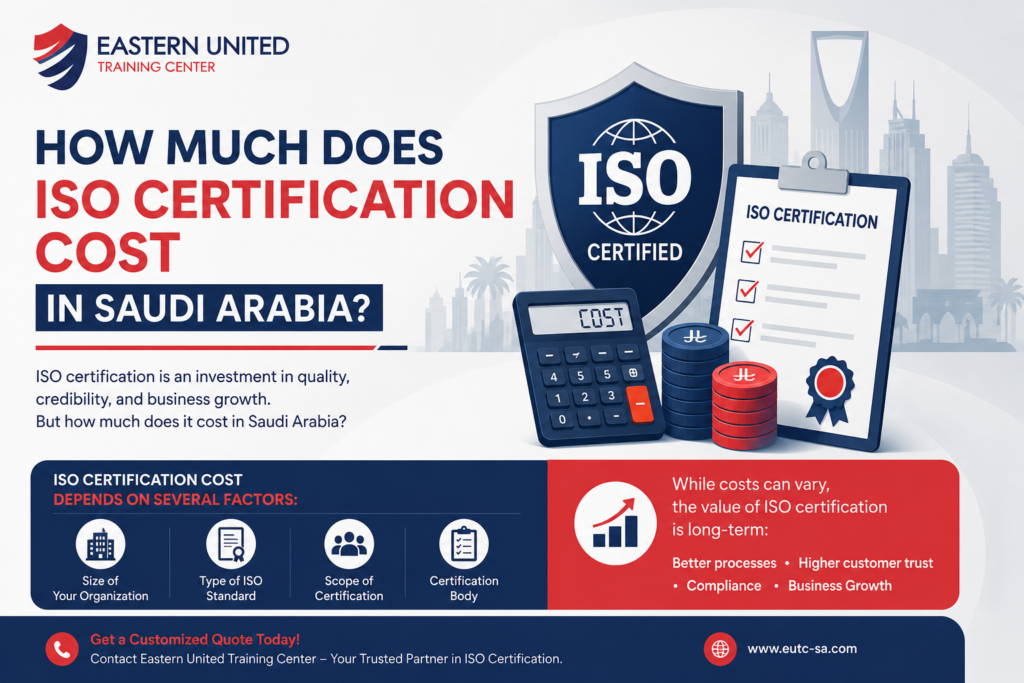
- 1 What Determines ISO Certification Cost in Saudi Arabia?
- 2 How Much Does ISO 9001 Certification Cost in Saudi Arabia?
- 3 How Much Does ISO 45001 Certification Cost in Saudi Arabia?
- 4 ISO 14001 and ISO 27001 Certification Costs in Saudi Arabia
- 5 Hidden Costs of ISO Certification in Saudi Arabia You Should Know
- 6 How to Reduce ISO Certification Cost in Saudi Arabia
- 7 Is ISO Certification Worth the Cost for Saudi Businesses?
- 8 Why Saudi Companies Choose EUTC Global and Eastren United Training Center for ISO Certification
- 9 Frequently Asked Questions About ISO Certification Cost in Saudi Arabia
- 9.1 How much does ISO 9001 certification cost in Saudi Arabia?
- 9.2 What factors affect ISO certification cost in Saudi Arabia?
- 9.3 Is ISO certification mandatory in Saudi Arabia?
- 9.4 How long does ISO certification take in Saudi Arabia?
- 9.5 Which ISO certification is best for Saudi companies?
- 9.6 Can small businesses afford ISO certification in Saudi Arabia?
- 9.7 What is included in ISO certification fees in Saudi Arabia?
- 9.8 How often is ISO certification renewal required?
- 10 Final Thoughts
If you’re running a business in Saudi Arabia and wondering what ISO certification will actually cost you, here’s the straightforward answer: expect to pay anywhere from 20,000 SAR to 120,000 SAR for the complete process. This amount depends on your company size, the ISO standard you’re pursuing, and your current readiness level.
The total expense breaks down into several components. These include consulting services (3,000 SAR to 50,000 SAR), certification body audit fees (15,000 SAR to 60,000 SAR), implementation costs, employee training, and documentation development. Small businesses with fewer than 25 employees typically sit at the lower end. Larger organizations with multiple branches or complex operations will pay more.
For Saudi companies in Riyadh, Jeddah, Dammam, or anywhere in the Kingdom, understanding these costs upfront helps with proper budgeting and avoids surprises. Many business owners underestimate the investment, only to discover additional expenses midway through the process. This guide breaks down every cost factor to help you make an informed decision.
TL;DR: ISO certification in Saudi Arabia costs between 20,000–120,000 SAR depending on company size, standard type, and complexity. Consulting services range from 3,000–50,000 SAR, while certification body fees run 15,000–60,000 SAR (Arab Academy, 2026). Annual maintenance costs 5,000–20,000 SAR after initial certification.
What Determines ISO Certification Cost in Saudi Arabia?
ISO certification costs in Saudi Arabia can vary significantly. Factors like organization size, number of locations, and working shifts cause prices to change dramatically (QCertify Global, 2026). A single-location startup in Riyadh won’t pay the same amount as a manufacturing facility operating across three cities with multiple shifts.
Here are the main factors that’ll affect your final ISO certification cost:
Company Size and Employee Count
- 1–25 employees: 20,000–45,000 SAR
- 26–65 employees: 40,000–70,000 SAR
- 66–125 employees: 60,000–95,000 SAR
- 126+ employees: 85,000–120,000+ SAR
Number of Sites and Locations
Multi-site certification adds complexity. If you operate branches in Riyadh, Jeddah, and Dammam, expect additional costs for each location. Most certification bodies charge extra for multi-site audits. However, some offer reduced rates for secondary locations.
Industry Sector and Complexity
A construction company pursuing ISO 45001 faces different challenges than an IT firm going for ISO 27001. High-risk industries or those with intricate processes require more extensive documentation and implementation time.
Current Process Maturity
Companies with established quality management systems spend less. ISO certification in Riyadh can become significantly cheaper if the company already has strong existing processes and practices in place (TopCertifier, 2026). Starting from scratch costs more.
Chosen ISO Standard
- ISO 9001 (Quality): Generally the most affordable.
- ISO 45001 (Occupational Health & Safety): Moderate complexity.
- ISO 14001 (Environmental): Moderate complexity.
- ISO 27001 (Information Security): Most expensive due to technical requirements.
Certification Body Selection
International certification bodies (like BSI, SGS, TÜV) typically charge more than local Saudi certification bodies. However, international recognition might justify the premium for export-oriented businesses.
Our insight: We’ve seen Saudi companies reduce their certification costs by 30–40% by conducting thorough internal gap analyses before engaging consultants. This upfront work minimizes billable consulting hours.
How Much Does ISO 9001 Certification Cost in Saudi Arabia?
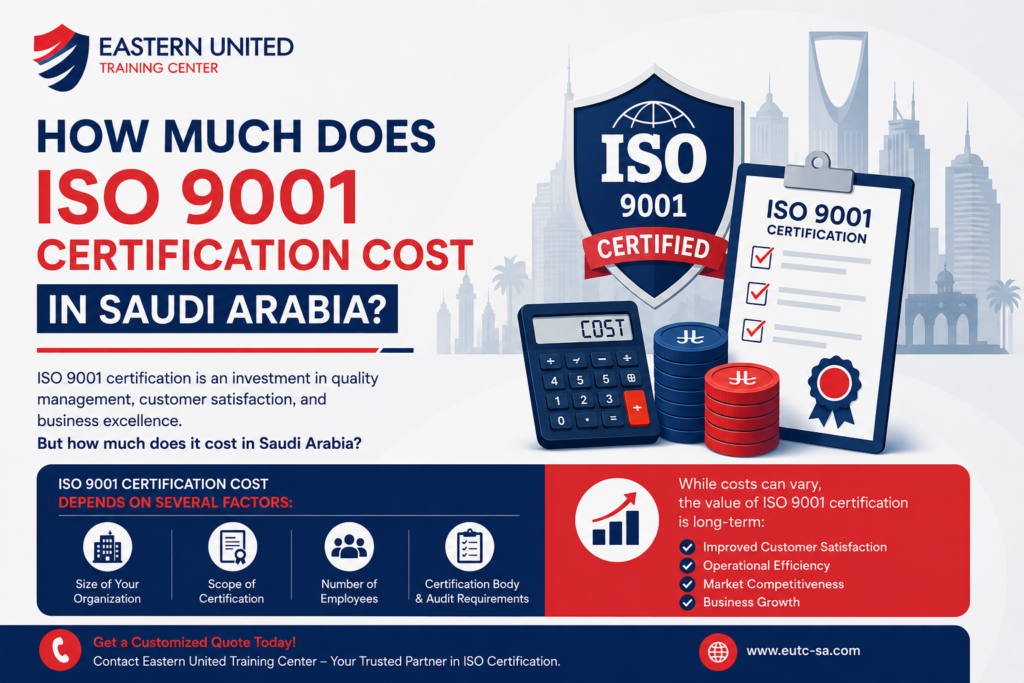
ISO 9001 certification, the most popular quality management standard, typically costs Saudi businesses between 25,000 to 65,000 SAR for small to medium enterprises. Consulting services, certification body fees, and annual maintenance form the main cost buckets (Arab Academy, 2026).
| Company Size | Consulting Fees | Certification Audit | Documentation | Training | Total Estimate |
| 1–25 employees | 8,000–15,000 SAR | 12,000–20,000 SAR | 3,000–5,000 SAR | 2,000–4,000 SAR | 25,000–44,000 SAR |
| 26–65 employees | 15,000–25,000 SAR | 18,000–28,000 SAR | 4,000–7,000 SAR | 3,000–6,000 SAR | 40,000–66,000 SAR |
| 66–125 employees | 20,000–35,000 SAR | 22,000–35,000 SAR | 5,000–10,000 SAR | 4,000–8,000 SAR | 51,000–88,000 SAR |
What’s Included in ISO 9001 Certification Fees
Consulting Services: Most Saudi companies work with ISO consultants who guide them through implementation. EUTC Global offer comprehensive packages. These include gap analysis, documentation development, and pre-audit support.
Gap Analysis: This initial assessment identifies where your current processes fall short of ISO 9001 requirements. Budget 3,000–8,000 SAR for a thorough gap analysis.
Documentation Development: You’ll need a quality manual, procedures, work instructions, and forms. Professional documentation services cost 3,000–10,000 SAR, depending on complexity.
Internal Auditor Training: Training 2–3 employees as internal auditors costs 2,000–5,000 SAR per person. Many companies choose EUTC Global for their practical training approach.
Certification Audit Fees: The external certification body conducts a two-stage audit. Stage 1 reviews documentation (typically 40% of total audit cost), and Stage 2 assesses actual implementation (60% of cost).
Annual Surveillance: After certification, you’ll pay for annual surveillance audits. These are roughly 30–40% of the initial certification audit cost.
How Much Does ISO 45001 Certification Cost in Saudi Arabia?
ISO 45001, the occupational health and safety standard, typically runs between 30,000 to 75,000 SAR for Saudi businesses. This standard is particularly relevant for construction companies, factories, and industrial operations where worker safety is paramount.
| Cost Component | Small Business (1–50 emp.) | Medium Business (51–125 emp.) | Large Organization (126+ emp.) |
| Consultant fees | 10,000–20,000 SAR | 18,000–32,000 SAR | 28,000–45,000 SAR |
| Risk assessment support | 3,000–6,000 SAR | 5,000–10,000 SAR | 8,000–15,000 SAR |
| HSE documentation | 4,000–8,000 SAR | 6,000–12,000 SAR | 10,000–18,000 SAR |
| Employee training | 3,000–7,000 SAR | 6,000–12,000 SAR | 10,000–20,000 SAR |
| Certification audit | 15,000–25,000 SAR | 22,000–35,000 SAR | 30,000–50,000 SAR |
| Total | 35,000–66,000 SAR | 57,000–101,000 SAR | 86,000–148,000 SAR |
Why ISO 45001 Costs More Than Other Standards
The standard requires extensive hazard identification and risk assessment activities. For construction and manufacturing sectors in Saudi Arabia, this means:
- Site-specific safety assessments.
- Emergency response planning.
- Personal protective equipment evaluations.
- Contractor safety management systems.
- Incident investigation procedures.
Companies in Dammam’s industrial zones or Jubail’s manufacturing sector often need specialized HSE consultants who understand local regulations and Saudi Aramco contractor requirements.
ISO 45001 Implementation Timeline in Saudi Arabia
A structured ISO 45001 implementation in Saudi Arabia typically takes 4 to 6 months from gap analysis to certification audit (SGC Consulting, 2026). Rush implementations are possible, but may incur 20–30% premium fees.
ISO 14001 and ISO 27001 Certification Costs in Saudi Arabia
ISO 14001 Environmental Management System Cost
ISO 14001 costs roughly 28,000 to 70,000 SAR depending on your environmental aspects and impacts. Manufacturing facilities, waste management companies, and industrial operations need this certification to demonstrate environmental responsibility.
Cost factors specific to ISO 14001:
- Environmental aspects and impacts assessment: 3,000–8,000 SAR.
- Legal compliance review: 2,000–6,000 SAR.
- Environmental monitoring and measurement setup: 4,000–12,000 SAR.
- Waste management documentation: 2,000–5,000 SAR.
- Certification audit: 15,000–30,000 SAR.
Many Saudi companies pursue ISO 14001 alongside ISO 9001 or ISO 45001 as an integrated management system. This approach can reduce overall costs by 15–25%.
ISO 27001 Information Security Certification Cost
ISO 27001 is the most expensive certification, ranging from 45,000 to 150,000 SAR for Saudi companies. The intricacy of information security requirements justifies the higher investment. ISO 27001 implementation in Saudi Arabia generally takes 6 to 9 months due to deeper information security risk assessment requirements (SGC Consulting, 2026).
| Cost Element | Small IT Company | Medium Enterprise | Large Organization |
| Gap analysis & risk assessment | 8,000–15,000 SAR | 12,000–25,000 SAR | 20,000–40,000 SAR |
| ISMS documentation | 10,000–20,000 SAR | 15,000–30,000 SAR | 25,000–50,000 SAR |
| Technical controls implementation | 5,000–15,000 SAR | 10,000–25,000 SAR | 20,000–45,000 SAR |
| Security awareness training | 3,000–8,000 SAR | 6,000–15,000 SAR | 12,000–25,000 SAR |
| Penetration testing (optional) | 5,000–12,000 SAR | 8,000–20,000 SAR | 15,000–35,000 SAR |
| Certification audit | 18,000–35,000 SAR | 28,000–50,000 SAR | 45,000–80,000 SAR |
| Total | 49,000–105,000 SAR | 79,000–165,000 SAR | 137,000–275,000 SAR |
Tech companies and financial institutions in Riyadh’s fintech sector prioritize ISO 27001, as it demonstrates data security commitment to clients and meets regulatory requirements from SAMA (Saudi Arabian Monetary Authority) and CITC (Communications and Information Technology Commission).
Our insight: Companies that invest in proper technical security controls (firewalls, encryption, access management) before starting ISO 27001 certification save 20–30% on implementation costs. The standard works best when technical foundations are already solid.
Hidden Costs of ISO Certification in Saudi Arabia You Should Know
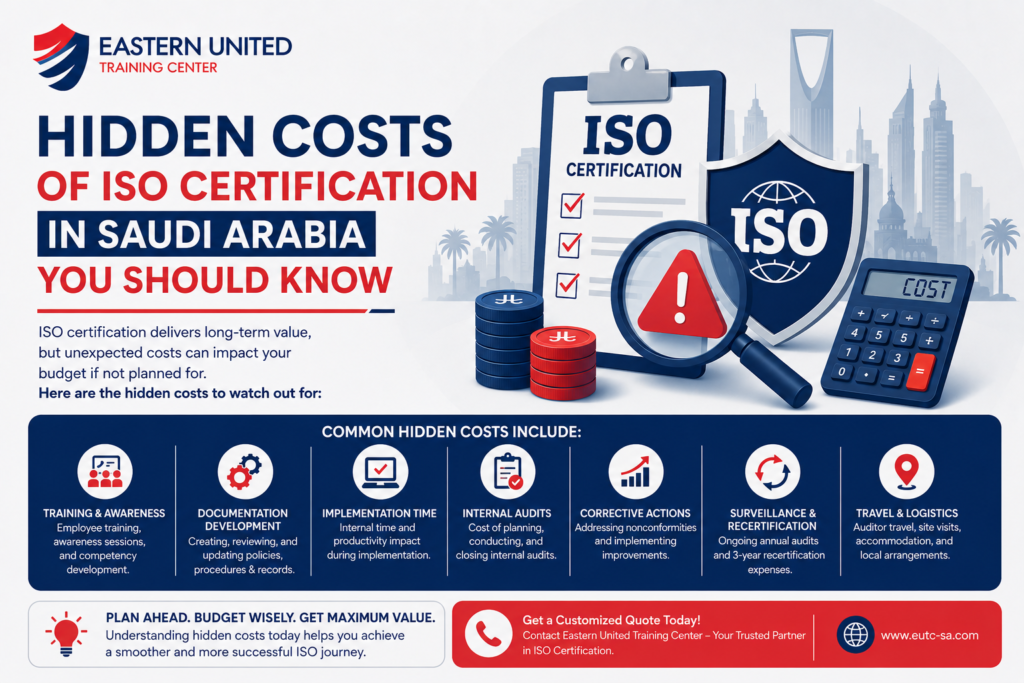
Beyond the obvious consultant and audit fees, several hidden costs catch Saudi business owners by surprise. Here’s what many companies don’t budget for initially:
Employee Time and Productivity
Your staff will spend significant time in meetings, training sessions, and documentation reviews. For a typical ISO 9001 implementation, expect:
- Management review meetings: 40–60 hours.
- Process mapping sessions: 60–100 hours.
- Document preparation: 80–150 hours.
- Internal audit participation: 20–40 hours.
This represents a real cost in terms of diverted attention from regular business activities.
Software and Tools
Quality management software or document control systems aren’t mandatory, but they make ISO maintenance much easier. Budget 5,000–20,000 SAR for decent software solutions.
Corrective Actions from Non-Conformities
If your certification audit identifies non-conformities, you’ll need to fix them. This might mean equipment purchases, facility modifications, or additional training. Set aside 10–20% of your total budget for unexpected corrective actions.
Travel Costs for Multi-Site Audits
If you have branches in multiple Saudi cities, auditors will charge travel expenses. Budget 2,000–5,000 SAR per additional location for accommodation and transportation.
Translation Services
Some certification bodies require documentation in English. Professional translation costs 50–150 SAR per page, which adds up quickly for extensive procedures and manuals.
Annual Maintenance and Recertification
Every three years, you’ll undergo recertification audits. While cheaper than initial certification, budget 60–70% of original certification costs. Annual maintenance and surveillance audits after ISO certification in Saudi Arabia can cost around 5,000–20,000 SAR per year (Arab Academy, 2026).
How to Reduce ISO Certification Cost in Saudi Arabia
Smart strategies can cut your ISO certification expenses by 25–40% without compromising quality or compliance. Here’s how:
- Start with Gap Analysis: Before hiring consultants, conduct your own gap analysis using free ISO checklists. Understanding your starting point helps you negotiate better consultant packages and reduces billable hours.
- Use Existing Systems: Don’t rebuild from scratch. Most Saudi businesses already utilize some quality procedures, even if informal. Document what’s working and build on it.
- Choose Integrated Management Systems: Pursuing multiple standards simultaneously (like ISO 9001 + ISO 45001) costs 30–40% less than implementing them separately. Shared documentation and combined audits create significant savings.
- Train Internal Staff: Instead of relying entirely on external consultants, train your team to handle implementation. EUTC Global offers affordable internal auditor courses that empower employees to manage the process.
- Select the Right Certification Body: Get quotes from at least three certification bodies. Prices vary significantly. Locally-recognized Saudi certification bodies often charge 20–30% less than international ones while still providing valid certification.
- Implement in Phases: If cash flow is tight, implement the standard in phases over 6–9 months rather than rushing it in 3–4 months. This spreads costs and reduces pressure on your team.
- Use Remote Audits When Possible: Since COVID-19, many certification bodies offer remote audit options for documentation review stages. This cuts travel costs and sometimes reduces audit fees by 10–15%.
- Bundle Services: Companies like Eastren United Training Center offer complete packages including consulting, training, and pre-audit support at bundled rates that cost less than purchasing services separately.
Practical Cost-Saving Example
A 40-employee trading company in Riyadh reduced their ISO 9001 certification cost from 55,000 SAR to 38,000 SAR by:
- Conducting their own initial gap analysis (saved 5,000 SAR).
- Using in-house staff for document writing with consultant review only (saved 8,000 SAR).
- Choosing a Saudi certification body (saved 4,000 SAR).
Is ISO Certification Worth the Cost for Saudi Businesses?
Let’s address the real question: will you see returns that justify spending 30,000–100,000 SAR on ISO certification?
Tangible Financial Benefits
Government Contract Access: Many Saudi government tenders require ISO 9001 certification. This opens opportunities worth millions of riyals. The Ministry of Municipal and Rural Affairs, Royal Commission projects, and Saudi Aramco contracts often mandate ISO certification.
Insurance Premium Reductions: Companies with ISO 45001 certification often negotiate 10–15% lower workers’ compensation insurance premiums. Over three years, this can recover a significant portion of certification costs.
Reduced Waste and Rework: ISO 9001 implementation typically reduces defects and rework by 15–30%. For a manufacturing company with 5 million SAR annual revenue, this means 75,000–150,000 SAR in savings annually.
Export Market Access: European and North American buyers increasingly require ISO certification from suppliers. If you’re targeting international markets, certification isn’t optional — it’s the entry ticket.
Intangible Benefits
- Enhanced company reputation in Saudi business circles.
- Improved employee morale through better-defined processes.
- Reduced management stress from standardized operations.
- Better risk management and business continuity.
- Structured approach to continuous improvement.
ISO Certification ROI Timeline in Saudi Arabia
Most Saudi SMEs recover their ISO certification investment within 18–24 months through new contracts, operational efficiencies, and reduced errors. Larger organizations often see ROI within 12–15 months.
When ISO Certification Might Not Be Worth It
Be honest about your situation. ISO certification might not make sense if:
- Your business model is rapidly changing and processes aren’t stable.
- You’re a very small business (under 10 employees) with limited growth plans.
- Your industry and customers don’t value or require certification.
- You lack management commitment to maintain the system long-term.
For startups, sometimes it’s better to wait until you have stable processes before pursuing certification. Focus on building your business first, then formalize it with ISO when you’re ready to scale.
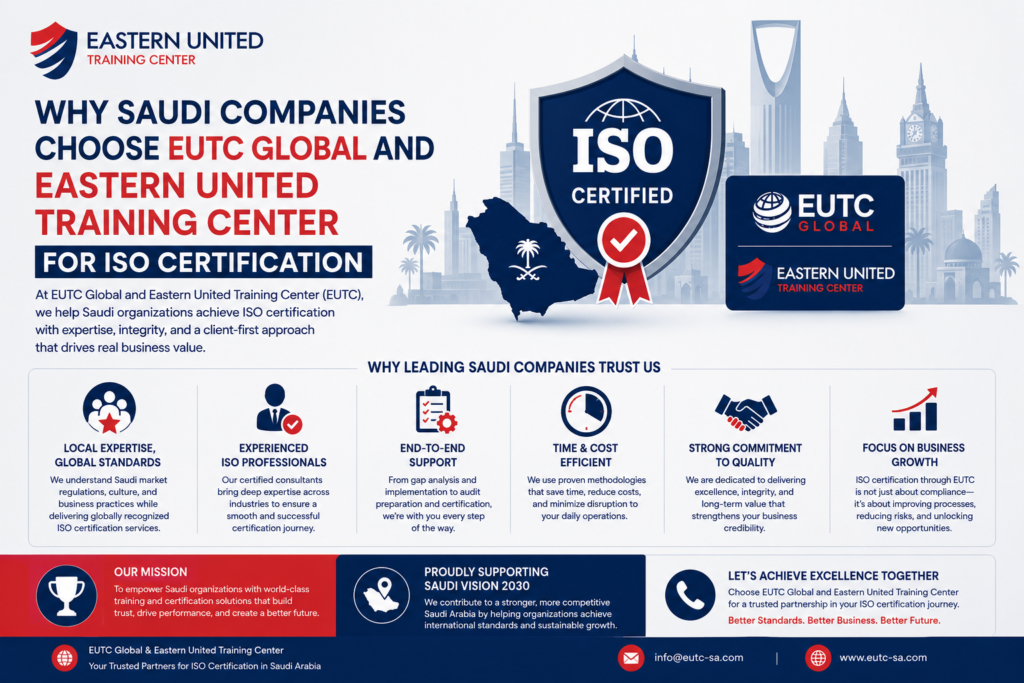
Why Saudi Companies Choose EUTC Global and Eastren United Training Center for ISO Certification
When it comes to ISO certification support in Saudi Arabia, Eastren United Training Center have built strong reputations for practical, results-focused service.
What Sets Them Apart
1. Local Market Understanding: They understand Saudi business culture, Vision 2030 requirements, and local compliance needs. Their consultants know how to align ISO standards with Saudi regulations and industry practices.
2. Industry-Specific Expertise: Whether you’re a construction contractor needing ISO 45001, an IT company pursuing ISO 27001, or a food manufacturer seeking ISO 22000, they offer specialized consultants who understand your sector.
3. Realistic Implementation Approaches: Rather than imposing complicated systems, they work with your existing processes and build practical solutions that employees actually use. No shelf-ware here.
4. Comprehensive Training Programs: Eastren United Training Center provides excellent internal auditor training. This gives your team the skills to maintain ISO certification long-term without ongoing consultant dependency.
5. Transparent Pricing: They provide detailed cost breakdowns upfront. This ensures you know exactly what you’re paying for, with no surprise fees midway through the project.
6. Post-Certification Support: Unlike consultants who disappear after certification, they offer ongoing support for surveillance audits and continuous improvement initiatives.
7. Proven Track Record: They’ve successfully certified hundreds of Saudi companies across Riyadh, Jeddah, Dammam, and other cities in various industries.
Typical Engagement Process
- Free initial consultation to understand your needs.
- Detailed proposal with clear cost breakdown.
- Gap analysis and implementation planning.
- Documentation development and process implementation.
- Internal audit training and pre-assessment.
- Certification audit support.
- Post-certification maintenance support.
Companies appreciate that both EUTC Global focus on building internal capability rather than creating long-term consultant dependency.
Frequently Asked Questions About ISO Certification Cost in Saudi Arabia
How much does ISO 9001 certification cost in Saudi Arabia?
ISO 9001 certification typically costs between 25,000 to 65,000 SAR for small to medium Saudi businesses. Consulting services range from 3,000–50,000 SAR depending on business size and complexity (Arab Academy, 2026). Total costs include consultant fees, certification audit charges, documentation development, employee training, and gap analysis. Larger organizations with 100+ employees may pay 70,000–100,000 SAR.
What factors affect ISO certification cost in Saudi Arabia?
The main factors include company size (employee count), number of sites or branches, industry complexity, chosen ISO standard, current process maturity, and certification body selection. ISO certification cost in Saudi Arabia varies greatly by organization size, number of locations, and working shifts (QCertify Global, 2026). Companies with established processes pay less, while those starting from scratch face higher implementation costs.
Is ISO certification mandatory in Saudi Arabia?
ISO certification isn’t legally mandatory for most Saudi businesses. However, it’s often required for government contracts, major corporate suppliers, and specific regulated industries. Companies bidding on Saudi Aramco projects, government infrastructure tenders, or export contracts frequently need ISO 9001, ISO 45001, or ISO 14001 certification.
How long does ISO certification take in Saudi Arabia?
A structured ISO 9001, ISO 45001, or ISO 14001 implementation typically takes 4 to 6 months from gap analysis to certification audit (SGC Consulting, 2026). ISO 27001 generally requires 6 to 9 months due to deeper information security risk assessment requirements. Rushed implementations are possible in 2–3 months but may compromise quality and cost more.
Which ISO certification is best for Saudi companies?
The best ISO certification depends on your industry and business goals. ISO 9001 suits virtually all sectors and is most commonly required. ISO 45001 is vital for construction, manufacturing, and industrial operations. ISO 14001 benefits companies with significant environmental impacts. ISO 27001 is critical for IT companies, financial institutions, and data-handling businesses. Most Saudi companies start with ISO 9001 as their foundation.
Can small businesses afford ISO certification in Saudi Arabia?
Yes, small Saudi businesses can definitely afford ISO certification. For companies with 10–25 employees, expect costs around 20,000–35,000 SAR for ISO 9001. Many certification bodies offer small business packages with reduced audit fees. Cost-saving strategies include conducting your own gap analysis, using internal staff for documentation, and choosing local certification bodies.
What is included in ISO certification fees in Saudi Arabia?
ISO certification fees typically include the Stage 1 documentation review audit, Stage 2 implementation audit, certification decision and certificate issuance, and first-year maintenance. Certification body fees typically range from 15,000–60,000 SAR (Arab Academy, 2026). Consulting services, documentation, training, and gap analysis are billed separately.
How often is ISO certification renewal required?
ISO certificates are valid for three years, with annual surveillance audits to maintain certification costing around 5,000–20,000 SAR per year (Arab Academy, 2026). At the end of three years, you undergo a recertification audit. Budget approximately 60–70% of your original certification cost for recertification.
Final Thoughts
ISO certification represents a significant investment for Saudi businesses. Nevertheless, it’s an investment that yields benefits through improved operations, new business opportunities, and competitive advantages in both domestic and international markets.
Understanding the true ISO certification cost in Saudi Arabia upfront prevents budget surprises and helps you make informed decisions. Whether you’re a small trading company in Riyadh, a construction contractor in Dammam, or a tech startup in Jeddah, there’s an ISO certification path that fits your budget and business goals.
Key Takeaways
- Budget 20,000–120,000 SAR for complete ISO certification depending on company size and standard.
- Consulting services (3,000–50,000 SAR) and certification audits (15,000–60,000 SAR) form the largest cost components.
- Annual surveillance costs 5,000–20,000 SAR to maintain certification.
- Implementation takes 4–9 months depending on the ISO standard.
- Companies can reduce costs by 25–40% through smart strategies like gap analysis, integrated systems, and staff training.
- ROI typically occurs within 18–24 months through new contracts and operational improvements.
- Hidden costs include employee time, corrective actions, software, and multi-site audit travel.
The question isn’t whether you can afford ISO certification — it’s whether you can afford to operate without it in Saudi Arabia’s increasingly competitive and regulated business environment. Companies like Eastren United Training Center make the process affordable and practical for Saudi businesses of all sizes.
Start by getting quotes from multiple consultants and certification bodies. Compare not just prices, but the value provided, industry expertise, and post-certification support. Your ISO certification journey is an investment in your company’s future. With proper planning and the right partners, it’s an investment that delivers measurable returns.