

Contents
- 1 Step-by-Step ISO Certification Process in Saudi Arabia
- 2 Required Documents for ISO Certification in Saudi Arabia
- 3 How Much Does ISO Certification Cost in Saudi Arabia?
- 4 Choosing the Right ISO Consultant in Saudi Arabia
- 5 Common Mistakes to Avoid During ISO Certification
- 6 Benefits of ISO Certification for Saudi Businesses
- 7 Frequently Asked Questions
- 7.0.1 How long does it take to get ISO certified in Saudi Arabia?
- 7.0.2 Do I need a consultant to get ISO certified in Saudi Arabia?
- 7.0.3 Which certification body should I choose in Saudi Arabia?
- 7.0.4 How much does ISO certification cost for small businesses in Saudi Arabia?
- 7.0.5 Can I get multiple ISO certifications simultaneously?
- 8 Conclusion
Getting ISO certified in Saudi Arabia isn’t as complicated as most business owners think. Whether you’re running a construction company, healthcare facility, food business, or startup, ISO certification demonstrates your commitment to quality, safety, and continuous improvement. The Kingdom has seen impressive growth in ISO adoption, making it easier than ever to find qualified consultants and certification bodies.
This guide walks you through every step of the ISO certification process in KSA, from choosing the right standard to maintaining your certificate. You’ll learn about timelines, costs, required documents, and common mistakes to avoid.
TL;DR: Saudi Arabia ranks 8th globally with 5,148 valid ISO 9001 certificates (ISO Survey, 2024). The typical certification process takes 4–6 months and involves gap analysis, implementation, internal audits, and certification audits. Working with an experienced ISO consultant like EUTC Global can simplify the process significantly.
What Is ISO Certification and Why It Matters in Saudi Arabia
ISO certification is third-party verification that your organization meets international standards for quality, safety, environmental management, or information security. Saudi Arabia had 2,488 ISO 9001 certificates in the previous survey year and has since grown to 5,148 certificates (ISO Survey, 2024). This demonstrates the Kingdom’s dedication to international quality standards.
For Saudi businesses, ISO certification offers several advantages:
- Enhanced credibility with government contracts and large corporations
- Access to international markets that require ISO compliance
- Improved operational efficiency and reduced waste
- Better risk management and regulatory compliance
- Competitive advantage in Vision 2030-aligned industries
The most common ISO standards in Saudi Arabia include:
- ISO 9001 Certification — Quality Management Systems
- ISO 14001 Certification — Environmental Management
- ISO 45001 Certification — Occupational Health & Safety
- ISO 22000 Certification — Food Safety Management
- ISO 27001 Certification — Information Security Management
Globally, there are 651,851 valid ISO 9001 certificates (ISO Survey, 2024), making it the most widely adopted management system standard worldwide.
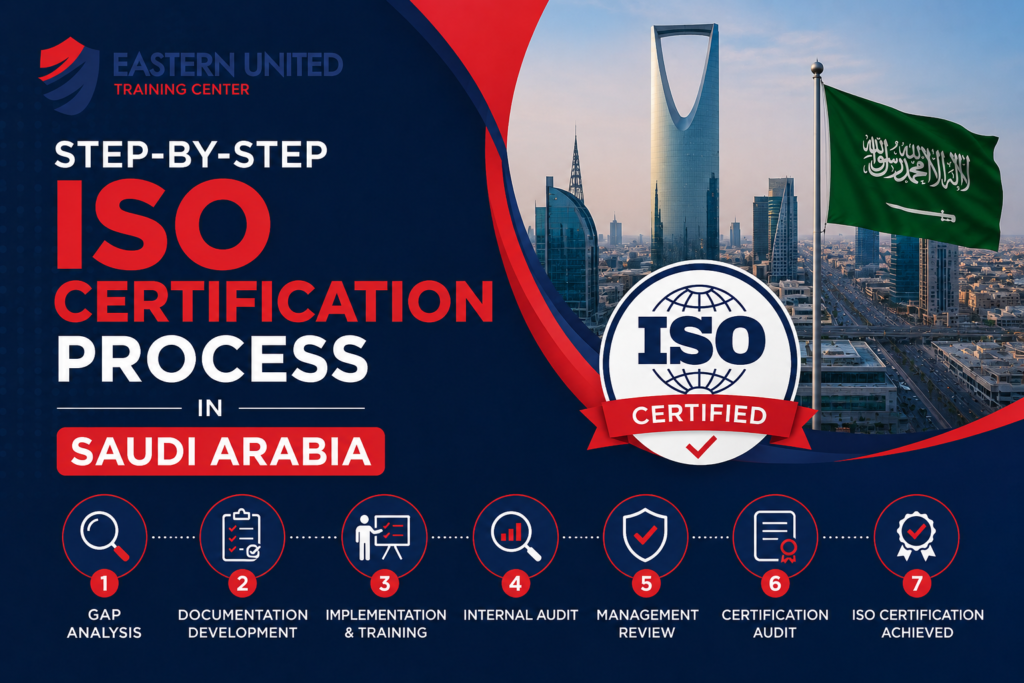
Step-by-Step ISO Certification Process in Saudi Arabia
A typical ISO 9001, ISO 45001, or ISO 14001 certification project in Saudi Arabia takes 4 to 6 months end-to-end. More complex standards like ISO 27001 require 6 to 9 months due to more in-depth security risk-assessment needs.
Here’s the complete process broken down:
Step 1: Choose Your ISO Standard
Identify which ISO standard aligns with your business needs:
- Manufacturing and service companies → ISO 9001
- Companies with environmental impact → ISO 14001
- Organizations with workplace safety concerns → ISO 45001
- Food processors and restaurants → ISO 22000
- IT companies handling sensitive data → ISO 27001
Step 2: Conduct a Gap Analysis
Before starting implementation, assess your current practices against ISO requirements. This helps you understand:
- Which processes already meet ISO standards
- What documentation you need to create
- What training your team requires
- Realistic timelines and budgets
Working with an experienced ISO consultant can complete a thorough gap analysis in 1–2 weeks. This can save you months of trial and error.
Step 3: Implementation Phase
The implementation phase for ISO certification usually lasts 8 to 16 weeks and includes staff training and embedding the management system in daily operations.
During implementation, you’ll:
- Develop required policies and procedures
- Create necessary documentation and forms
- Train employees on new processes
- Establish Key Performance Indicators (KPIs)
- Implement corrective action procedures
- Set up document control systems
Our insight: Many Saudi companies rush implementation to meet deadlines. However, the system should run for 3 to 4 months to generate records that demonstrate operational implementation before certification. This evidence is essential for passing your audit.
Step 4: Internal Audit
The internal audit phase typically takes 2 to 3 weeks before the certification audit. Your trained internal auditors (or your consultant) will:
- Review all documentation
- Verify process implementation
- Identify non-conformities
- Recommend corrective actions
- Ensure readiness for certification audit
Step 5: Management Review
Senior management reviews the internal audit findings and confirms:
- Resources are adequate
- Objectives are being met
- The system is suitable for your organization
- Necessary improvements are identified
Step 6: Certification Audit (Stage 1 and Stage 2)
The certification audit phase usually takes 2 to 4 weeks and includes Stage 1 (documentation) and Stage 2 (operational) audits.
Stage 1 Audit — Documentation Review:
- The certification body reviews your documentation
- Auditors verify your system design meets ISO requirements
- You receive a report of any documentation gaps
- This typically takes 1–2 days
Stage 2 Audit — Implementation Verification:
- Auditors visit your premises
- They observe processes in action
- They interview staff members
- Auditors review records and evidence
- They issue the audit report
- This typically takes 2–5 days depending on company size
If you pass both stages with no major non-conformities, you’ll receive your ISO certificate within 2–4 weeks.
Step 7: Maintain Your Certification
ISO certification isn’t a one-time achievement. You’ll need:
- Annual surveillance audits (1 day)
- Continual improvement activities
- Updated internal audits
- Management reviews
- Recertification every 3 years
Required Documents for ISO Certification in Saudi Arabia
Documentation requirements vary by standard, but most ISO certifications need:
Mandatory Documents:
- Quality/Management Manual
- Quality Policy statement
- Quality Objectives
- Documented procedures (typically 6–10 core procedures)
- Work instructions
- Forms and templates
- Records of implementation
Common Procedures Required:
- Document control
- Records management
- Internal audits
- Corrective and preventive actions
- Management review
- Training and competence
- Risk assessment (varies by standard)
Supporting Documents:
- Commercial Registration (CR)
- Company organization chart
- List of products/services
- Process flowcharts
- Employee training records
- Supplier evaluation records
- Calibration certificates (if applicable)
Our insight: Don’t create documentation for the sake of documentation. Develop practical, usable documents that actually improve operations rather than just satisfy auditors.
How Much Does ISO Certification Cost in Saudi Arabia?
ISO certification costs vary based on several factors: company size, number of locations, ISO standard complexity, current system maturity, consultant fees, and certification body fees.
Typical Cost Breakdown:
| Cost Component | Estimated Range (SAR) |
|---|---|
| Consultant fees | 15,000 – 60,000 |
| Certification body audit fees | 8,000 – 25,000 |
| Training costs | 5,000 – 15,000 |
| Documentation/software | 2,000 – 10,000 |
| Total (first year) | 30,000 – 110,000 |
Annual maintenance costs (surveillance audits) typically range from 5,000 to 15,000 SAR.
Remember that ISO certification is an investment, not an expense. Most companies see a return on investment through improved efficiency, reduced waste, and new business opportunities within 12–18 months.
Choosing the Right ISO Consultant in Saudi Arabia
Working with an experienced consultant can reduce your certification timeline by 30–50% and significantly increase your first-time pass rate.
What to Look for in an ISO Consultant:
- ✓ Local experience — Understanding of Saudi business culture and regulations
- ✓ Industry expertise — Experience in your specific sector
- ✓ Certified auditors — Staff with internationally recognized qualifications
- ✓ Transparent pricing — Clear breakdown of costs with no hidden fees
- ✓ Training capabilities — Ability to train your team, not just provide documents
- ✓ Post-certification support — Assistance with surveillance audits and ongoing improvement
EUTC Global specializes in helping Saudi companies achieve ISO certification efficiently. With a team of certified lead auditors and industry specialists, they provide end-to-end support from gap analysis to certification and beyond.
Their services include:
- Gap analysis and readiness assessment
- Document development
- Employee training programs
- Internal audit services
- Certification audit preparation
- Ongoing compliance support
Common Mistakes to Avoid During ISO Certification
1. Treating ISO as a Paper Exercise ISO should improve your operations, not just create paperwork. Focus on practical implementation that adds value.
2. Insufficient Employee Training Your team needs to understand and follow the system. Don’t skip training to save time or money.
3. Copying Templates Without Customization Generic templates don’t reflect your actual processes. Auditors will notice immediately.
4. Rushing the Implementation The total timeline for a complex ISO project such as ISO 27001 or an integrated management system is typically 6 to 9 months. Rushing leads to failed audits and wasted resources.
5. Lack of Top Management Commitment ISO requires leadership involvement. Without management support, implementation will fail.
6. Choosing the Cheapest Option Low-cost consultants often deliver poor-quality work. This costs more in the long run through failed audits and recertification fees.
7. Neglecting Internal Audits Regular internal audits identify issues before the certification body finds them.
Benefits of ISO Certification for Saudi Businesses
Beyond the obvious quality improvements, ISO certification offers:
Business Development:
- Required for many government tenders
- Opens doors to international markets
- Enhances corporate reputation
- Increases customer confidence
Operational Excellence:
- Standardized processes reduce errors
- Better resource management
- Clear responsibilities and accountability
- Data-driven decision making
Risk Management:
- Proactive issue identification
- Systematic approach to problem-solving
- Reduced liability exposure
- Improved workplace safety
Financial Performance:
- Reduced waste and rework
- Lower insurance premiums (especially with ISO 45001)
- Improved productivity
- Better supplier relationships
Employee Satisfaction:
- Clearer roles and expectations
- Better training and development
- Safer working conditions
- Increased engagement
Frequently Asked Questions
How long does it take to get ISO certified in Saudi Arabia?
For standard certifications like ISO 9001, ISO 14001, or ISO 45001, expect 4–6 months from start to finish. More complex standards like ISO 27001 typically require 6–9 months. The timeline depends on your company size, current system maturity, and available resources for implementation.
Do I need a consultant to get ISO certified in Saudi Arabia?
No, a consultant isn’t mandatory, but it’s highly recommended. Companies working with experienced consultants like EUTC Global typically achieve certification 30–50% faster with higher first-time pass rates. Consultants provide expertise, save internal resources, and help avoid common mistakes that lead to failed audits.
Which certification body should I choose in Saudi Arabia?
Choose an accredited certification body recognized by SAAC (Saudi Accreditation Center) or international accreditation bodies like UKAS, IAS, or JAS-ANZ. Popular options in Saudi Arabia include SGS, Bureau Veritas, TÜV, LRQA, and Intertek. Your consultant can recommend the best fit for your industry and budget.
How much does ISO certification cost for small businesses in Saudi Arabia?
Small businesses (under 25 employees) typically spend 30,000–50,000 SAR for their first ISO certification, including consultant fees, certification body costs, and training. Annual surveillance audits cost approximately 5,000–8,000 SAR. These costs are often recovered through operational improvements and new business opportunities within the first year.
Can I get multiple ISO certifications simultaneously?
Yes, and it’s often more efficient. An integrated management system (IMS) combining ISO 9001, ISO 14001, and ISO 45001 shares common elements, reducing documentation and audit time. EUTC Global specializes in integrated systems that save time and resources compared to pursuing certifications separately.
Conclusion
Getting ISO certified in Saudi Arabia is a strategic investment that strengthens your business foundation. With Saudi Arabia ranking 8th globally in ISO 9001 certificates and the Kingdom’s continued focus on quality standards under Vision 2030, now is the ideal time to pursue certification.
Key Takeaways:
- Start with the right standard — Choose the ISO certification that aligns with your business goals
- Plan for 4–6 months — Don’t rush the process; proper implementation requires time
- Invest in a qualified consultant — Experienced consultants significantly improve success rates
- Focus on practical implementation — ISO should improve operations, not just create paperwork
- Budget appropriately — Expect 30,000–110,000 SAR depending on complexity
- Commit to ongoing improvement — ISO certification requires continued effort beyond the initial audit
Ready to start your ISO certification journey? Contact an ISO consultant like EUTC Global for a free gap analysis and personalized roadmap to certification.