

Contents
- 1 Why HSE Training Selection Matters More Than Ever in Saudi Arabia
- 2 What Makes EUTC Global Different from Other HSE Training Providers?
- 3 The Complete HSE Training Provider Comparison: What Actually Matters
- 4 Breaking Down Training Quality: What “Practical HSE Training” Actually Means
- 5 Aramco and SABIC Training Requirements: Why Alignment Matters
- 6 The Economics of HSE Training: Understanding Real Costs vs. Value
- 7 Who Should Choose EUTC Global? (And Who Shouldn’t)
- 8 Frequently Asked Questions
- 8.1 Which is the best HSE training provider in Saudi Arabia?
- 8.2 Is EUTC Global recognized in Saudi Arabia?
- 8.3 Does EUTC provide Aramco-aligned safety training?
- 8.4 What safety certifications are most valuable in KSA?
- 8.5 Which HSE course is best for oil and gas workers?
- 8.6 Does EUTC offer corporate on-site safety training?
- 8.7 What is the difference between OSHA and NEBOSH training?
- 8.8 Are EUTC certifications internationally recognized?
- 8.9 How much do HSE courses cost in Saudi Arabia?
- 9 Key Takeaways: Making Your HSE Training Provider Decision
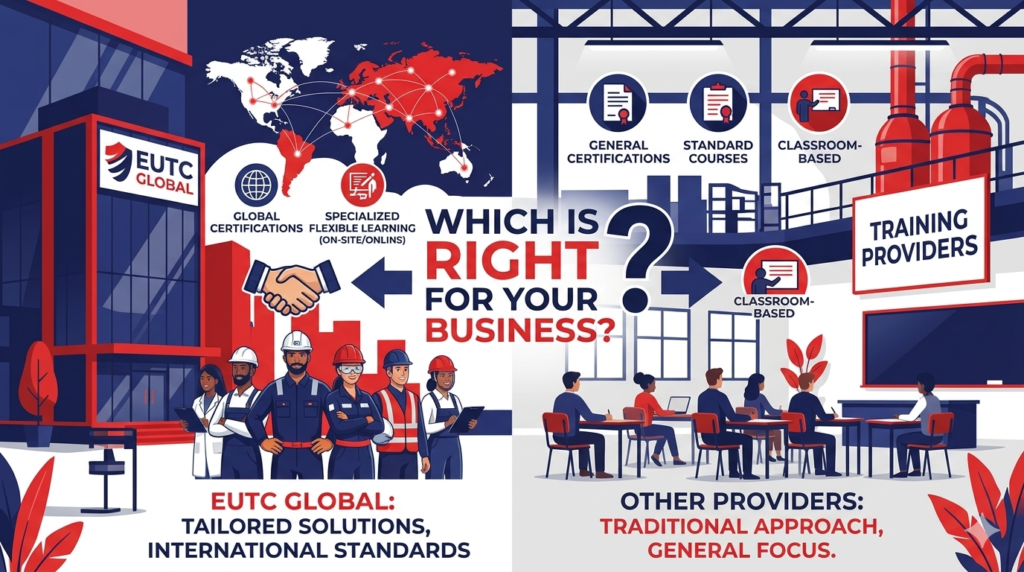
If you’re an HSE manager or business owner in Saudi Arabia searching for the best safety training center in KSA, you’ve likely encountered dozens of options. EUTC Global presents itself as a practical, Aramco-aligned training provider with bilingual instruction and flexible corporate training solutions. But how does it actually compare to other HSE training providers in the Kingdom?
Here’s what sets EUTC Global apart: they focus heavily on hands-on, compliance-driven training that reflects real industrial environments, particularly for oil and gas operations. Their instructors bring actual field experience from Aramco and SABIC projects, not just academic credentials. They offer on-site corporate training in both Arabic and English, which matters for companies with diverse workforces. However, they’re not the most affordable option, and their course catalog, while comprehensive, isn’t as extensive as some international giants.
This comparison breaks down exactly where EUTC excels, where competitors might fit better, and what you should consider when choosing an HSE certification provider.
TL;DR: EUTC Global stands out for Aramco-aligned, practical HSE training with bilingual support and corporate flexibility. According to the ILO (2024), 2.78 million workers die annually from occupational accidents—choosing the right training provider isn’t just about certificates, it’s about building real workplace safety capabilities.
Why HSE Training Selection Matters More Than Ever in Saudi Arabia
According to the World Economic Forum (2025), 60% of workers will require training before 2027 due to evolving skill needs. In Saudi Arabia specifically, Vision 2030’s ambitious industrial expansion means more construction sites, manufacturing facilities, and infrastructure projects—all requiring certified safety professionals.
The Kingdom is targeting 300,000+ jobs in the tourism sector alone by 2030, expanding safety training needs beyond traditional oil and gas (Saudi Vision 2030, 2024). Construction represents one of the highest injury-prone sectors across the GCC, making proper HSE training a regulatory necessity, not just a checkbox.
Why this matters for your business:
- Non-compliance can halt operations or disqualify you from major contracts.
- Aramco and SABIC vendor requirements are strict and specific.
- The quality gap between providers affects actual workplace safety outcomes.
- International certifications open doors to regional and global projects.
Most companies don’t fail safety audits because they lack certificates. They fail because their teams received theoretical training that didn’t translate to real-world application.
Our insight: The cheapest training provider will cost you more in the long run if their certification doesn’t meet Aramco specs or their graduates can’t identify hazards on-site. We’ve seen companies retrain entire teams after choosing providers based solely on price.
What Makes EUTC Global Different from Other HSE Training Providers?
The ILO (2024) reports that 374 million non-fatal work-related injuries occur annually worldwide—a figure that proper training directly addresses. EUTC Global’s approach centers on reducing that statistic through practical, scenario-based learning rather than classroom-only instruction.
Core differentiators:
Industry-aligned curriculum: EUTC designs courses around actual Saudi industrial requirements, particularly Aramco’s safety protocols. This isn’t just about passing exams—it’s about meeting the exact standards your company faces during audits.
Instructor backgrounds: Their trainers aren’t career educators. They’re former HSE managers, site supervisors, and safety officers from oil and gas, construction, and manufacturing operations. They’ve written JSAs, conducted incident investigations, and implemented safety management systems.
Bilingual delivery: Truly effective safety training happens in the language your team thinks in. EUTC offers courses in Arabic and English, with materials translated accurately—not just run through automated tools.
Corporate training flexibility: They’ll bring instructors to your facility, customize content to your specific hazards, and schedule around your operational requirements. You’re not forcing your team into generic public courses.
Certification recognition: EUTC provides internationally recognized certifications including NEBOSH, OSHA, and IOSH, alongside Aramco-approved specialized courses.
The Complete HSE Training Provider Comparison: What Actually Matters
Deloitte’s Global Human Capital Trends (2024) found that 81% of organizations prioritized improving employee safety and well-being in 2024. But choosing the right training partner requires looking beyond marketing claims.
Here’s how EUTC Global stacks up against other prominent HSE training providers in Saudi Arabia:
| Criteria | EUTC Global | Large International Providers | Local Training Centers | Online-Only Platforms |
|---|---|---|---|---|
| Training Quality | High – practical focus | Very High – standardized | Variable – depends on instructors | Medium – theory-heavy |
| Instructor Experience | Industry veterans (10–20 years) | Mixed – some academic | Variable – often entry-level | Usually academic only |
| Aramco/SABIC Alignment | Excellent – courses reflect requirements | Good – global standards adapted | Variable – not always updated | Poor – generic content |
| On-site Corporate Training | Yes – fully customizable | Limited – mostly public courses | Sometimes – smaller scale | No – digital only |
| International Certifications | NEBOSH, OSHA, IOSH recognized | Extensive catalog | Limited – local certs focus | Varies – check accreditation |
| Course Variety | Comprehensive – 50+ courses | Extensive – 100+ courses | Limited – 20–30 courses | Broad but generic |
| Hands-on Practical Sessions | Emphasized – real equipment | Good – depends on location | Variable – space constraints | None – simulations only |
| Arabic & English Support | Full bilingual – materials + instruction | English primarily | Arabic focus | Usually English only |
| Pricing Transparency | Clear quotes – corporate discounts | Higher – brand premium | Budget-friendly | Lowest cost |
| Customer Support | Direct contact – account managers | Ticket systems – slower | Personal but limited resources | Automated – impersonal |
What this comparison reveals:
EUTC Global hits the sweet spot for companies needing Aramco-aligned, practical training with Arabic support. International providers offer more course variety but at premium prices and often with less local relevance. Local centers provide budget options but may lack standardization. Online platforms can’t provide the hands-on component that industrial safety requires.
Breaking Down Training Quality: What “Practical HSE Training” Actually Means
The World Economic Forum (2025) projects that 44% of workers’ skills will be disrupted by 2027, making quality training investments more critical than ever. But “quality” in HSE training doesn’t mean thick binders and PowerPoint marathons.
What sets effective HSE training apart:
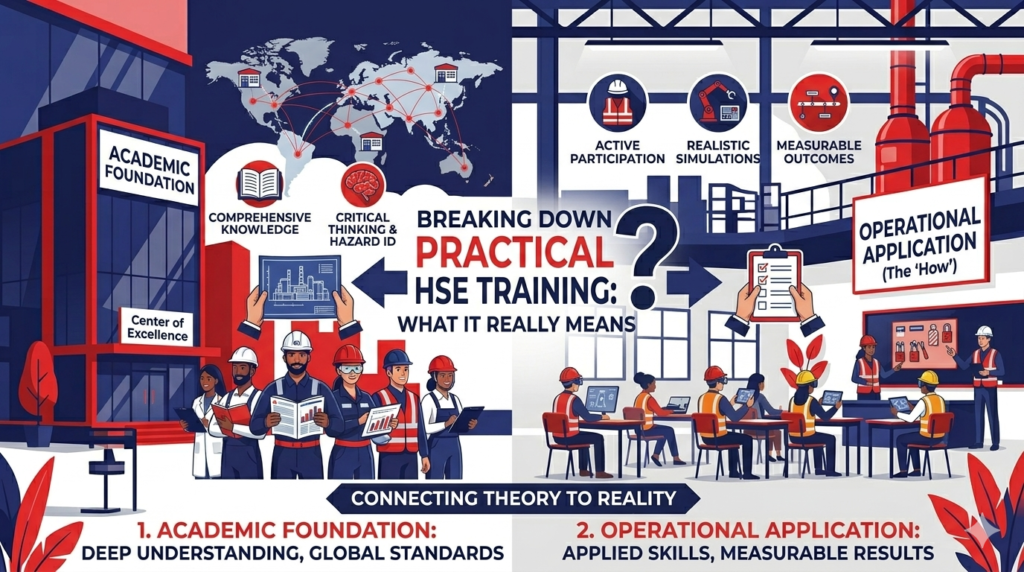
Scenario-based learning: EUTC structures courses around real incidents and near-misses from Saudi industrial sites. Students work through actual hazard identification scenarios they’ll encounter on-site, not generic textbook examples.
Equipment familiarity: Proper training includes handling actual PPE, gas detectors, fire extinguishers, and rescue equipment. You can’t learn confined space entry procedures from a slideshow.
Regulatory application: Understanding the theory behind a regulation matters less than knowing how to implement it. Effective training shows you how to write compliant JSAs, conduct proper inspections, and document findings correctly.
Assessment rigor: Certificates should be earned, not handed out for attendance. EUTC’s pass rates hover around 85%, not 100%—which tells you they maintain standards.
Training delivery methods comparison:
| Delivery Method | Best For | EUTC Offering | Typical Alternatives |
|---|---|---|---|
| In-person practical | Hands-on skills (rescue, firefighting) | Standard in most courses | Often separate add-on |
| On-site corporate | Team training at your facility | Available with customization | Limited or very expensive |
| Public scheduled | Individual certifications | Regular monthly sessions | Most common format |
| Blended learning | Theory + practical combination | Available for some courses | Growing trend |
| Pure e-learning | Basic awareness, refreshers | Limited selection | Increasingly common |
Our insight: We’ve audited dozens of safety training programs. The providers that produce competent safety officers—not just certificate holders—all share one trait: at least 40% of course time involves practical application, not just watching demonstrations.
Aramco and SABIC Training Requirements: Why Alignment Matters
According to the ILO (2024), 15% of workplace deaths globally result from exposure to harmful substances or environments—exactly the scenarios Aramco’s safety standards address. When your company works with Aramco or SABIC, generic safety training won’t suffice.
Why Aramco alignment is essential:
Aramco maintains some of the most stringent safety requirements globally. Their vendor qualification process explicitly checks whether your safety personnel hold appropriate certifications and whether your training records meet their standards. Get this wrong, and you won’t make the approved vendor list.
What Aramco-aligned training includes:
- Permit-to-Work systems: Understanding Aramco’s specific PTW procedures, not generic permit concepts.
- Isolation and lockout protocols: Their LOTO standards differ from general OSHA approaches.
- Gas testing requirements: Specific atmospheric monitoring procedures and acceptable limits.
- Emergency response procedures: Coordination with Aramco’s emergency teams and communication protocols.
- Incident reporting: Their investigation methodology and documentation requirements.
EUTC Global structures courses around these specific requirements because their instructors came from these environments. They’re teaching what they actually implemented, not what they read about.
Other providers’ approach:
Large international training providers teach globally recognized standards, which are excellent foundations. However, they often require you to bridge the gap between OSHA 30-hour or NEBOSH IGC content and Aramco’s specific applications. Local providers may claim Aramco alignment without having worked within their systems.
Certification combinations that work for Aramco vendors:
- NEBOSH International General Certificate + Aramco-specific orientation.
- OSHA 30-Hour Construction + Saudi Building Code awareness.
- IOSH Managing Safely + Aramco contractor safety requirements.
- Specialized certifications (confined space, working at height) aligned with Aramco procedures.
The Economics of HSE Training: Understanding Real Costs vs. Value
Saudi Arabia’s Vision 2030 aims to increase SME contribution to GDP from 20% to 35% by 2030, expanding the pool of companies needing compliance training (Saudi Vision 2030, 2024). This growth means more businesses evaluating training costs—but the cheapest option rarely delivers the best value.
Actual HSE training costs in Saudi Arabia (2024 ranges):
| Course Type | Budget Providers | EUTC Global Range | Premium International |
|---|---|---|---|
| NEBOSH IGC | 6,000–8,000 SAR | 9,500–11,500 SAR | 13,000–16,000 SAR |
| OSHA 30-Hour | 2,500–3,500 SAR | 4,000–5,000 SAR | 6,000–8,000 SAR |
| First Aid/CPR | 800–1,200 SAR | 1,500–2,000 SAR | 2,500–3,500 SAR |
| Confined Space | 1,500–2,000 SAR | 2,500–3,500 SAR | 4,000–5,500 SAR |
| Corporate On-site (per day) | 5,000–8,000 SAR | 10,000–15,000 SAR | 18,000–25,000 SAR |
Hidden costs that cheap training creates:
- Recertification needs: If your training provider’s certificate isn’t accepted by Aramco or your client, you’ll pay twice.
- Operational delays: Inadequately trained personnel make mistakes that stop work.
- Audit failures: Having to retrain after failing compliance audits costs more than doing it correctly initially.
- Incident costs: Poor training directly correlates with higher incident rates and associated costs.
What you’re actually paying for:
- Instructor quality: Industry experience costs more than academic-only backgrounds.
- Facility standards: Proper practical training spaces with real equipment.
- Material quality: Professionally developed, localized content versus generic translations.
- Support services: Account management, scheduling flexibility, certificate tracking.
- Certification validity: Recognition by Aramco, SABIC, and international bodies.
Get ISO certification consultation for complete compliance.
Our insight: Companies that choose training based solely on price typically spend 2-3x more within two years through retraining, audit failures, and incident costs. The “expensive” provider often delivers better ROI.
Who Should Choose EUTC Global? (And Who Shouldn’t)
The World Economic Forum (2025) identifies that 64% of employers cite skills gaps as their biggest barrier to transformation. Understanding which training provider matches your specific needs prevents wasting resources on the wrong fit.
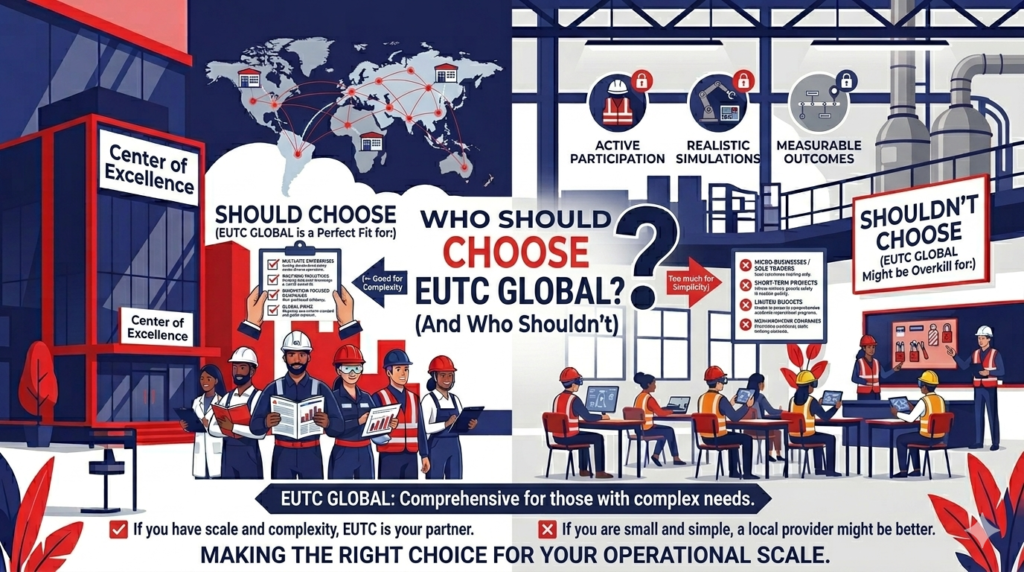
EUTC Global is ideal for:
HSE Managers and Safety Officers: If you’re responsible for building or maintaining a safety program, particularly in industrial environments, EUTC’s practical approach and instructor experience provides immediate applicability. You won’t need to translate theory into practice—they bridge that gap.
Oil and Gas Contractors: Companies working on Aramco, SABIC, or other petrochemical projects need training that mirrors these environments exactly. EUTC’s instructors speak this language fluently because they’ve worked in these operations.
Construction Companies: Especially those handling infrastructure projects where Saudi Building Code compliance and international safety standards intersect. EUTC covers both local requirements and international best practices.
Manufacturing Businesses: Factories dealing with industrial hazards (chemical handling, machinery safety, confined spaces) benefit from scenario-based training using similar environments.
Aramco and SABIC Vendors: If vendor qualification depends on demonstrating strong HSE programs, EUTC’s recognized certifications and alignment with these companies’ standards streamline approval.
Consider alternatives if:
You need niche specialized certifications: Large international providers offer more specific specializations (offshore safety, nuclear facility training, advanced ergonomics). EUTC focuses on core industrial safety.
Budget is your primary constraint: Local training centers or online-only platforms provide more affordable options. Just ensure the certification meets your requirements before committing.
You prefer pure self-paced online learning: EUTC emphasizes practical, instructor-led training. If you want completely asynchronous learning, online-only platforms suit that preference better.
You’re outside Saudi Arabia: While EUTC could support regional operations, providers with local presence in your country might offer better logistical convenience.
Your industry is non-industrial (retail, hospitality basic safety): Generic workplace safety awareness doesn’t require industrial-focused providers. Simpler, more affordable options work fine.
Comparison: Who should use which provider type?
| Your Situation | Best Provider Type | Why |
|---|---|---|
| Aramco vendor needing certification | EUTC Global or similar industrial-focused provider | Alignment with specific Aramco and industrial requirements |
| Small team, limited budget | Local training center | Cost-effective for basic compliance needs |
| Large corporation, 100+ employees | EUTC Global Corporate Training | Customization, bilingual support, and on-site efficiency |
| Individual career development | International provider or EUTC Global | Broad certification recognition and practical exposure |
| Retail/office basic safety | Online platform or local provider | Sufficient for low-risk workplace environments |
| Emergency response team building | EUTC Global or specialized provider | Strong emphasis on hands-on practical training and drills |
Frequently Asked Questions
Which is the best HSE training provider in Saudi Arabia?
“Best” depends on your specific needs. According to Deloitte (2024), 81% of organizations prioritize employee safety, making the right provider critical. EUTC Global excels for Aramco-aligned industrial training with a practical focus. Large international providers offer broader catalogs but at higher costs. Local centers provide budget options. Evaluate providers based on certification recognition, instructor experience, and alignment with your industry’s specific requirements rather than reputation alone.
Is EUTC Global recognized in Saudi Arabia?
Yes, EUTC Global provides internationally recognized certifications including NEBOSH, OSHA, and IOSH, which are widely accepted throughout Saudi Arabia and the GCC. Their courses align with Aramco and SABIC requirements, making their training valuable for vendor qualification. However, always verify that specific certifications meet your client’s or employer’s requirements before enrolling, as requirements can vary by project and contract.
Does EUTC provide Aramco-aligned safety training?
EUTC Global specifically designs courses around Aramco’s safety protocols and vendor requirements. Their instructors bring direct experience from Aramco projects, teaching procedures like Permit-to-Work systems, isolation protocols, and emergency response coordination that match Aramco’s standards. This alignment helps companies meet vendor qualification requirements more efficiently than adapting generic international safety training.
What safety certifications are most valuable in KSA?
The most valuable certifications depend on your industry, but NEBOSH International General Certificate remains the gold standard for HSE professionals across Saudi Arabia. OSHA 30-Hour Construction and General Industry certifications are widely recognized. First Aid/CPR, confined space, working at height, and scaffolding inspector certifications address specific operational needs. The ILO (2024) reports 2.78 million annual workplace deaths globally—proper certification directly impacts reducing this figure. Aramco vendors often need multiple certifications covering both general HSE management and specific hazards.
Which HSE course is best for oil and gas workers?
For oil and gas workers, NEBOSH International Technical Certificate in Oil and Gas Operational Safety provides the most comprehensive industry-specific training. However, most workers start with NEBOSH IGC or OSHA certifications as foundations, then add specialized courses: H2S safety, confined space entry, working at height, rigging and lifting, and emergency response. The ILO (2024) identifies harmful substance exposure as causing 15% of global workplace deaths—oil and gas environments concentrate these hazards, making specialized training essential rather than optional.
Does EUTC offer corporate on-site safety training?
Yes, EUTC Global provides customizable corporate on-site training, bringing instructors and equipment to your facility. This approach allows training on your actual equipment, addressing your specific hazards, and scheduling around operational requirements. On-site training works particularly well for teams of 8+ employees needing the same certification, offering better value than sending individuals to public courses while minimizing operational disruption.
What is the difference between OSHA and NEBOSH training?
OSHA training (developed by the US Occupational Safety and Health Administration) focuses on American regulations and compliance requirements, using specific OSHA standards. NEBOSH (National Examination Board in Occupational Safety and Health) offers UK-based international qualifications emphasizing risk assessment, management systems, and hazard control principles applicable globally. In Saudi Arabia, both are recognized. NEBOSH is often preferred for HSE manager roles requiring strategic safety management, while OSHA provides practical worker-level training. Many companies require both—NEBOSH for management, OSHA for supervisors and workers.
Are EUTC certifications internationally recognized?
EUTC Global’s certifications through NEBOSH, OSHA, and IOSH are internationally recognized across the GCC, Europe, and globally wherever these accrediting bodies are accepted. However, specific country requirements vary. According to the World Economic Forum (2025), 60% of workers will need training before 2027—international recognition ensures your certification remains valuable as you advance your career regionally or globally. Always verify that your target employer or country recognizes the specific certification you’re pursuing.
How much do HSE courses cost in Saudi Arabia?
HSE course costs in Saudi Arabia range from approximately 800 SAR for basic first aid to 16,000+ SAR for comprehensive NEBOSH diplomas. NEBOSH IGC typically costs 9,500-11,500 SAR depending on the provider. OSHA 30-Hour courses range from 2,500-5,000 SAR. Corporate on-site training costs 10,000-15,000 SAR per day depending on the provider and customization level. Saudi Vision 2030’s expansion increases training demand, but prices remain competitive regionally. Budget providers offer lower costs but verify certification acceptance before committing.
Key Takeaways: Making Your HSE Training Provider Decision
Choosing the best safety training center in KSA requires balancing practical considerations with your specific operational needs. EUTC Global offers a compelling middle ground—more practical and locally aligned than purely international providers, more standardized and recognized than budget local centers.
Remember these decision factors:
- Certification recognition matters more than brand names: Verify that your chosen provider’s certificates meet Aramco, SABIC, or your client’s specific requirements before enrolling.
- Instructor experience translates directly to training quality: Former HSE managers and site supervisors teach differently than career academics—both have value, but industry experience provides immediate applicability.
- Practical training components are essential: If your role involves implementing safety procedures, handling equipment, or responding to emergencies, hands-on training is not optional.
- Language accessibility affects learning outcomes: Safety training in your team’s working language produces better comprehension and retention than forcing everyone into English-only courses.
- Price reflects value but doesn’t guarantee it: The most expensive provider isn’t automatically the best, but the cheapest rarely delivers adequate outcomes for industrial environments.
The ILO (2024) reports that 374 million non-fatal workplace injuries occur annually worldwide. Every safety professional you train properly reduces your company’s contribution to that statistic. Every shortcut in training quality increases your risk exposure.
Your HSE training provider isn’t just checking compliance boxes. They’re building your company’s safety culture, determining whether your team can identify hazards before incidents occur, and establishing whether your certifications open or close doors to major contracts.