

Authorized Gas Tester (AGT) Training in Saudi Arabia
Certified training for personnel appointed to conduct atmospheric gas testing for confined space entry, hot work permits, and hazardous area operations across KSA. Aligned with Aramco GI 2.709, OSHA 1910.146, API RP 2016 and ANSI/ISA 12.13.01.
Get Free Training Quote
Fill out the form below for instant pricing
🔰 Trusted by more than 500 Organizations and Individuals
Certified AGT Training Aligned With Aramco GI 2.709, OSHA 1910.146, API RP 2016 and ANSI/ISA 12.13.01
EUTC Global delivers Authorized Gas Tester training built around Saudi Aramco General Instruction GI 2.709, OSHA 29 CFR 1910.146 confined space entry standards, API RP 2016 storage tank entry guidelines, and API RP 49 sour-gas operations. The course covers atmospheric testing, gas behaviour and relative density, multi-gas detector operation, calibration, and permit sign-off for confined space entry and hot work, the exact competencies that oil and gas, petrochemical, and construction employers across the Eastern Province, Jubail, Yanbu, and Riyadh require from an appointed gas tester. Every participant works hands-on with real gas detection equipment during the practical sessions. Delivered at our Al Khobar centre or on-site at your facility anywhere in the Kingdom.
What Is Authorized Gas Tester Training?
AGT training certifies the person responsible for making the atmosphere safe before anyone else goes in. It is one of the most critical roles on any industrial site in Saudi Arabia.
The Role, The Standard, and Why It Matters in KSA
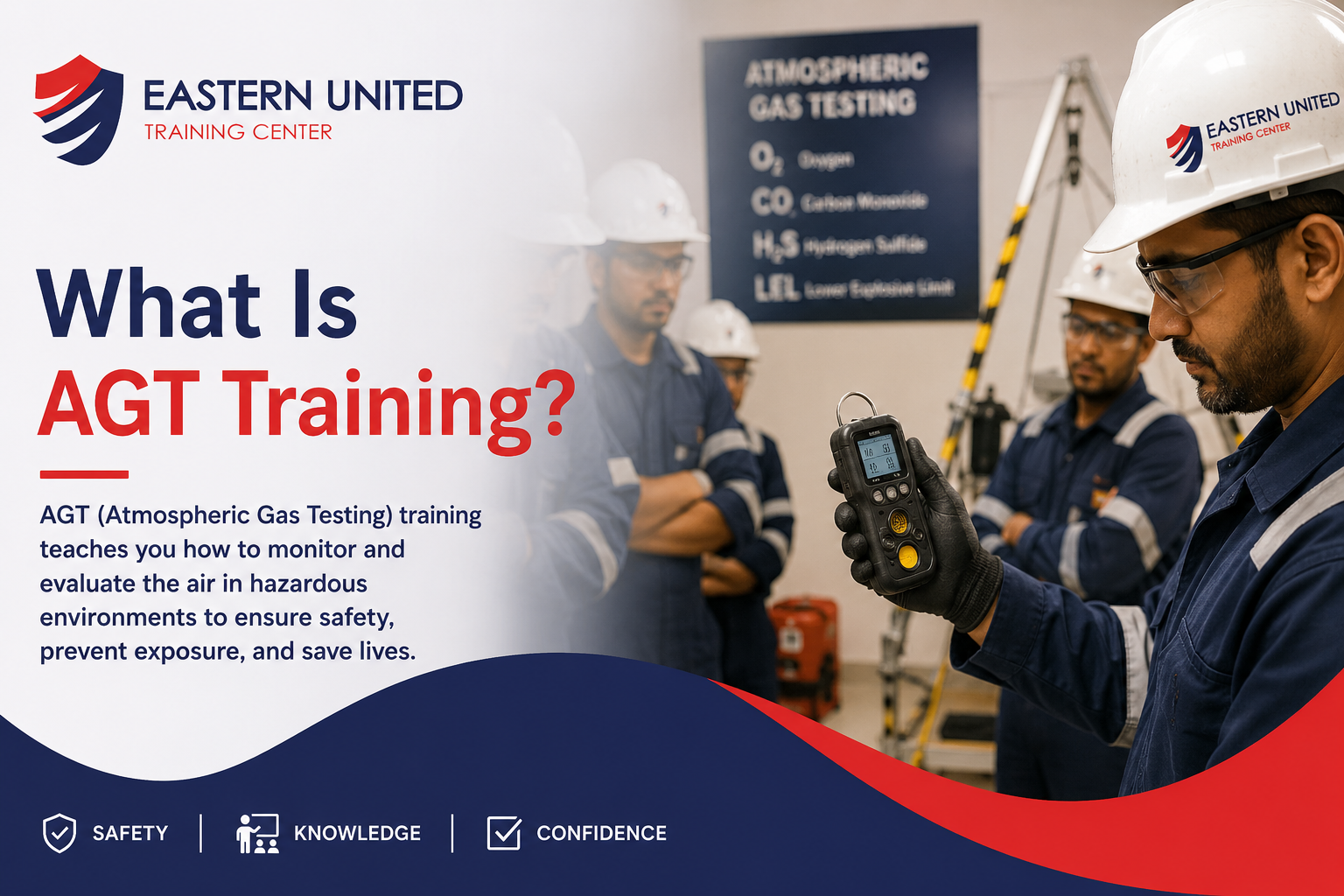
An Authorized Gas Tester is the formally appointed person responsible for testing and continuously monitoring the atmosphere in confined spaces, hot work areas, and hazardous zones before and during any work activity. The AGT tests for oxygen level, flammable gas concentration, and toxic gases, then signs off on the permits that allow work to proceed. Without a valid AGT sign-off, no confined space entry or hot work is legally permitted.
In Saudi Arabia, this role is governed by Saudi Aramco General Instruction GI 2.709. Any contractor or vendor company operating on Aramco facilities must ensure their appointed AGTs hold recognized AGT certification. OSHA 29 CFR 1910.146 imposes the same requirement for confined space work, and API RP 2016 sets the equivalent expectation for entry into petroleum storage tanks. An unqualified person performing gas testing is not just a safety risk. It is a compliance violation that results in immediate stop work and contract consequences.
To become an Authorized Gas Tester in KSA, you complete EUTC Global's eight-module AGT course, everything required to prepare a competent, confident gas tester. From reading a multi-gas detector correctly and interpreting an oxygen, LEL, or H2S reading, to signing off the Aramco hot work form SA 9873-2, every skill in this course maps directly to what the AGT does on site.
Course Details at a Glance
What Does an Authorized Gas Tester Do?
Three core responsibilities that make the AGT the most important safety appointment on any confined space or hot work job in Saudi Arabia
Test the Atmosphere
Before anyone enters a confined space or hot work begins, the AGT tests the atmosphere for oxygen level, flammable gas percentage (LEL), and toxic gas concentrations including H2S, CO, and site-specific chemicals. Because gas behaviour and relative density cause concentrations to vary by height, testing happens at top, middle, and bottom levels inside the space. The AGT then makes the go or no-go decision on whether conditions are safe enough for work to proceed.
Issue Work Clearance
The AGT is the person who signs the confined space entry permit and the hot work permit. Without the AGT's signature confirming safe atmospheric conditions, work cannot legally begin. On Aramco facilities this means completing the SA 9873-4 confined space entry form and the SA 9873-2 hot work form. The AGT carries legal accountability for the clearance they issue. This is not a tick-box role.
Continuous Monitoring
Atmospheric conditions change during work. Welding creates combustion products. Purging displaces oxygen. Product residue off-gases as surfaces warm up. The AGT continuously monitors conditions throughout the work activity and has stop-work authority if any reading exceeds the safe limit. Under Aramco GI 2.709, hot work atmospheres are re-tested every 30 minutes as a minimum.
What You Will Learn in This Course
Eight core competencies covering the full scope of authorized gas tester responsibilities across Saudi Arabia's industrial environments
Role and Responsibilities of an AGT
Legal appointment requirements, stop-work authority, liability as a certified gas tester, and how the AGT fits into the permit to work system under Saudi Aramco GI 2.709.
Atmospheric Hazards and Gas Behaviour
Oxygen deficiency and enrichment, flammable gases with LEL and UEL explained, and how gas behaviour, relative density, heavier-than-air versus lighter-than-air, and neutral buoyancy decide where you test. Plus the chimney effect in tall process columns.
Exposure Limits and Alarm Thresholds
OEL, STEL, and IDLH for H2S, CO, SO2, and benzene. What each alarm level means for the AGT's response action and when work must stop immediately versus when a warning is sufficient.
Multi Gas Detector Training KSA
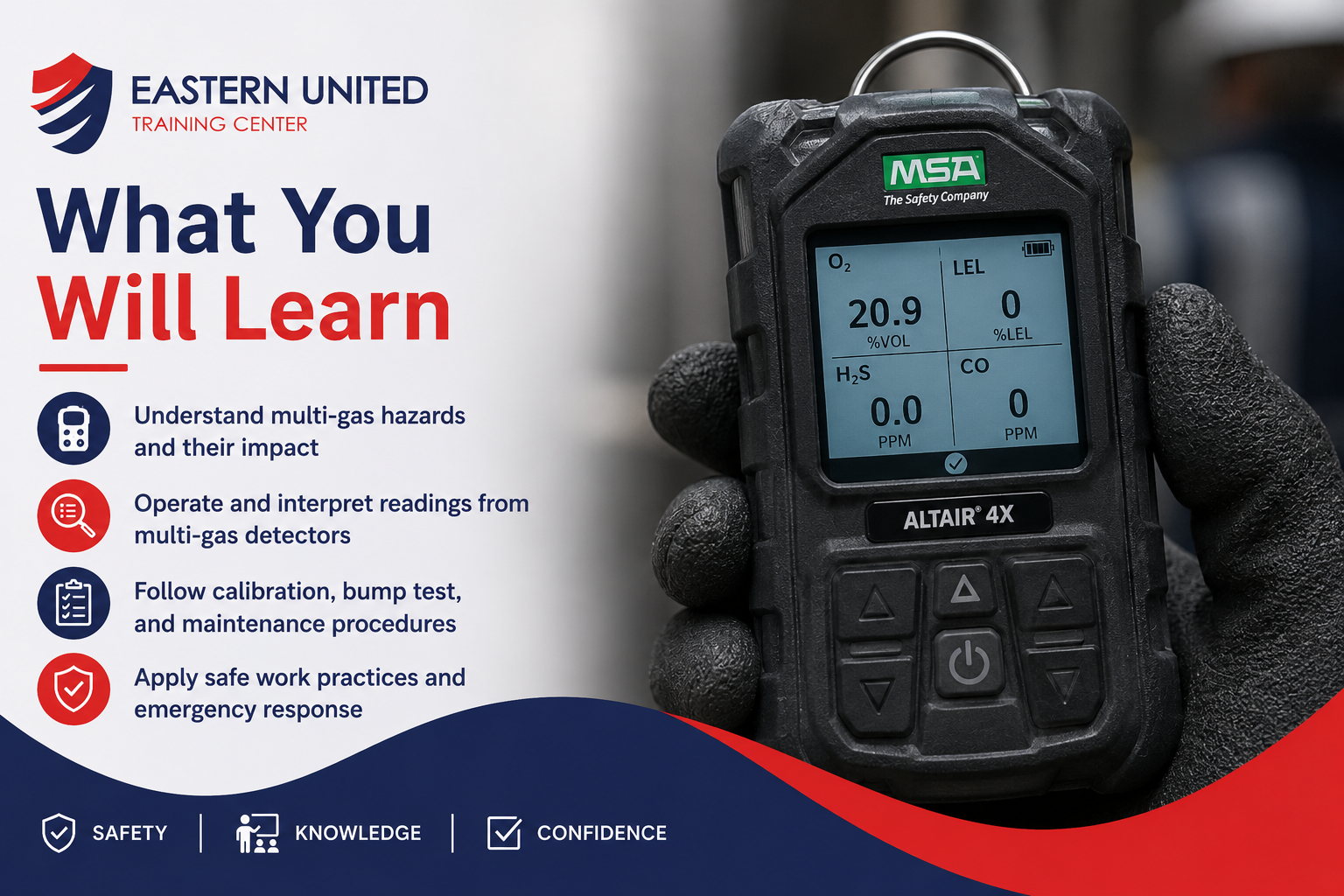
Operation of multi-gas detectors measuring O2, LEL, H2S, and CO simultaneously. Single-gas monitors, fixed gas detection systems, sensor types (catalytic bead, infrared, electrochemical, PID), and detector limitations.
Bump Test Calibration Training
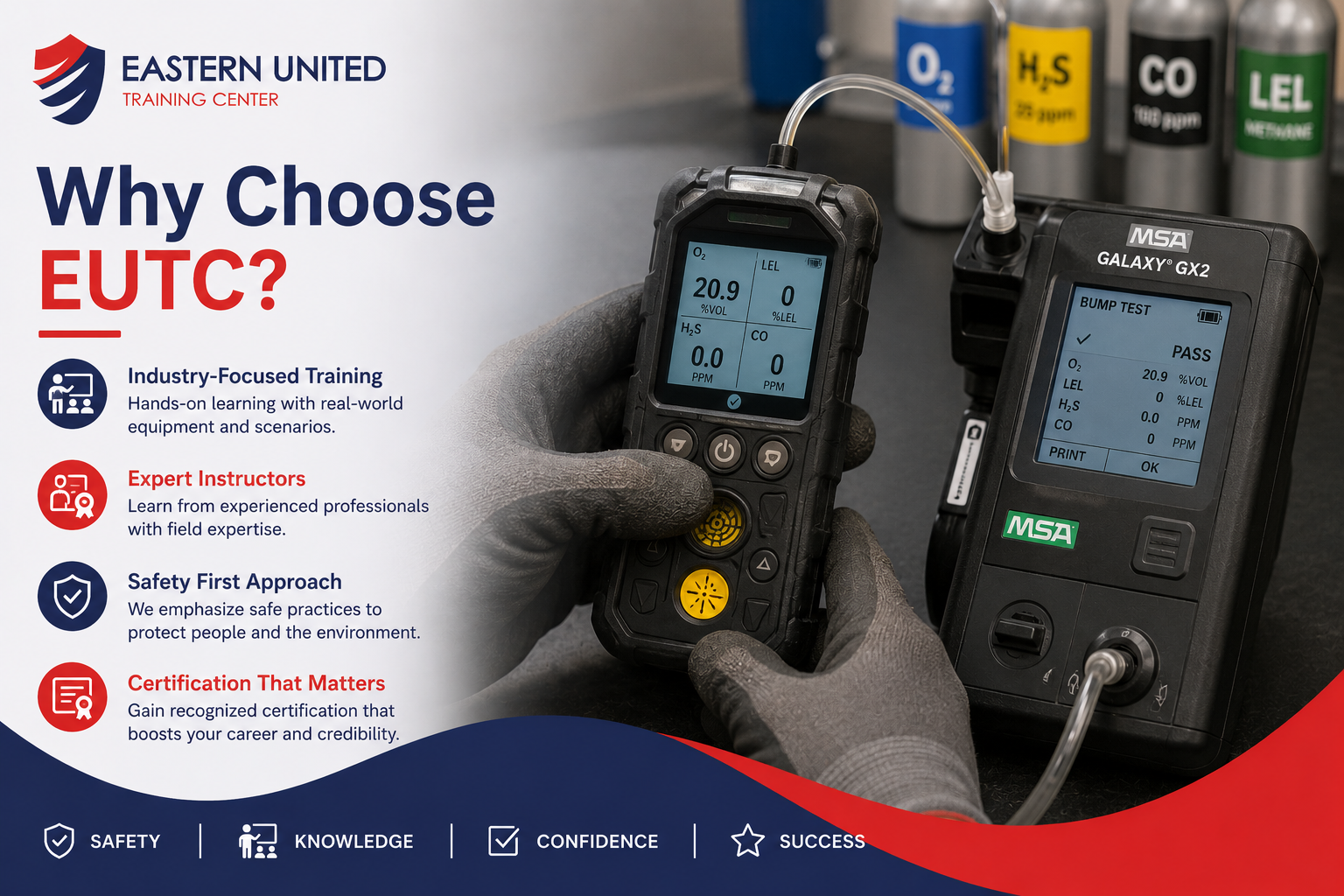
Daily bump test procedure, full calibration frequency and technique, calibration gas selection, sensor failure modes like poisoning and drift, and the documentation records that satisfy Aramco site inspection.
Confined Space Atmospheric Testing
Pre-entry testing sequence, testing at top, middle, and bottom levels, acceptable readings before entry, continuous monitoring requirements, and permit sign-off procedures under OSHA 1910.146.
Hot Work Gas Testing Course Saudi Arabia
LEL must reach 0 percent before hot work is permitted. Re-testing every 30 minutes during welding and cutting. Aramco hot work gas test certificate SA 9873-2 completion and suspension criteria.
Documentation and Reporting
Gas test permit forms, confined space entry permit Saudi Arabia completion, incident reporting after unsafe readings, and the documentation trail that satisfies gas testing permit to work Saudi Arabia requirements.
AGT Course Modules
Eight structured modules from AGT legal responsibilities to live practical assessment with real gas detection equipment
Role of the Authorized Gas Tester
- Legal definition of an AGT under Saudi law, Aramco GI 2.709, and OSHA 29 CFR 1910.146
- How the AGT is formally appointed by their employer and what that appointment means legally
- AGT responsibilities: testing, permit sign-off, continuous monitoring, and stop-work authority
- The relationship between the AGT, permit issuer, permit receiver, and site safety officer
- What happens legally if an unqualified person performs gas testing on an Aramco site
Atmospheric Hazards and Gas Behaviour
- Oxygen normal range: 20.9 percent and why deviation in either direction is dangerous
- Oxygen deficiency below 19.5 percent: physiological effects by level from impaired judgment to death
- Oxygen enrichment above 23.5 percent: increased fire and explosion risk explained
- LEL UEL gas testing oil gas concept: why working between the limits is immediately life-threatening
- Toxic gases: H2S, CO, SO2, benzene exposure limits and what each means for safe entry
- Gas behaviour: relative density, heavier-than-air and lighter-than-air gases, and neutral buoyancy
- Gas dispersion and the chimney effect in tall process columns and vertical vessels
- Inert gases: argon and nitrogen asphyxiation risk in confined spaces without visible warning
- How atmospheric conditions change during work activities: purging, welding, product off-gassing
Gas Detection Equipment
- Types of gas detectors: catalytic bead, infrared, electrochemical, and photoionization (PID)
- Multi-gas detector operation for O2, LEL, H2S, and CO simultaneous readings
- Single-gas personal monitors: selection criteria and limitations in confined spaces
- Fixed gas detection systems and how to read control panel alarm states
- Sensor failure modes: poisoning, drift, and suspect zero or high readings, plus ANSI/ISA 12.13.01 detector performance criteria
- Equipment selection for specific hazards: matching the detector to the process environment
Bump Testing and Calibration
- The difference between a bump test and a full calibration and when each is required
- Daily bump test procedure: exposure gas, response check, pass or fail criteria
- Full calibration frequency, procedure, and calibration gas concentration selection
- Calibration records: what Aramco site inspectors and permit to work systems require
- Equipment failure during pre-entry testing: what to do and who to notify
Confined Space Gas Testing
- Pre-entry atmospheric testing sequence: what to test, in what order, and at what locations
- Testing at multiple levels (top, middle, bottom) and why layering matters for heavy gases like H2S
- Acceptable entry levels: O2 between 19.5 and 23.5 percent, LEL below 10 percent, H2S below 10 ppm, CO below 35 ppm
- Nitrogen purging and the oxygen re-test required before reintroducing hydrocarbons
- Standby man and gas monitor role at the entry point, and making the go or no-go decision
- Continuous monitoring during confined space work and re-testing after any work interruption
- Confined space entry permit Saudi Arabia sign-off procedure under OSHA 1910.146 and Aramco GI 2.709
Hot Work Gas Testing Course Saudi Arabia
- What qualifies as hot work in Saudi Arabia: welding, cutting, grinding, and spark-generating activities
- Why LEL must reach exactly 0 percent before any hot work permit can be issued
- Re-testing intervals during active hot work: minimum every 30 minutes under Aramco GI 2.709
- Completing Aramco hot work form SA 9873-2 correctly as the signing AGT
- When to suspend hot work based on readings and how to document the suspension
Permit to Work Integration
- How the permit to work gas tester role fits into the overall permit to work system on Saudi industrial sites
- Confined space entry permit SA 9873-4: sections the AGT completes and signs
- Hot work permit: AGT clearance requirements before permit issuance
- AGT stop-work authority: when and how to exercise it, and what the documentation trail must show
- Coordination with permit issuer and site safety officer during multi-trade work activities
Practical Assessment
- Live multi-gas detector operation exercise with real equipment under instructor observation
- Bump test and full calibration demonstration using calibration gas cylinders
- Confined space pre-entry atmospheric test simulation with permit sign-off
- Hot work gas test scenario including SA 9873-2 form completion
- Written MCQ examination covering all theory modules
- Certificate issued same day on passing both written and practical assessments
Who Should Attend AGT Training?
Who needs AGT certification in KSA: anyone appointed or likely to be appointed as the site gas tester on confined space, hot work, or hazardous area operations
Oil and Gas Field Workers
Personnel working near wells, pipelines, and process areas where atmospheric testing is required before any confined space or hot work activity begins.
Confined Space Entry Workers
Anyone responsible for testing and clearing an atmosphere before confined space entry. This is the core role the AGT course was built around.
Hot Work Supervisors
Welders, cutters, and the supervisors overseeing hot work activities. The AGT clears the atmosphere and signs the hot work permit before a single spark is struck.
Safety Officers and HSE Personnel
Site HSE staff managing permit to work systems across Aramco, SABIC, and Royal Commission for Jubail and Yanbu projects need current AGT certification to oversee and verify gas testing.
Construction Site Supervisors
Supervisors on Aramco, SABIC, and Royal Commission for Jubail and Yanbu construction projects where confined space and hot work activities require an appointed AGT before work proceeds.
Aramco and SABIC Vendor Employees
AGT training Aramco vendors must complete is a documented requirement under GI 2.709. Contractor staff appointed as AGTs must hold recognized AGT certification Saudi Arabia employers provide.
Maintenance and Shutdown Workers
Turnaround teams working in process equipment, vessels, and storage tanks at refineries and petrochemical plants like Sadara, Petro Rabigh, and Luberef face some of the highest-concentration atmospheric hazards in KSA.
AGT Training vs Confined Space Entry Training
Understanding the difference between AGT and confined space training helps you certify the right people for the right roles on your site.
| Feature | AGT Training | Confined Space Entry Training |
|---|---|---|
| Primary Role | Gas Tester and Permit Signer | Entrant and Standby Attendant |
| Gas Testing (Core Skill) | ✓ Full Practical | Basic Awareness Only |
| Multi-Gas Detector Operation | ✓ | Monitor Reading Only |
| Bump Test and Calibration | ✓ | ✗ |
| Permit Sign-Off Authority | ✓ | ✗ |
| Hot Work Gas Clearance | ✓ | ✗ |
| Stop-Work Authority | ✓ | ✗ |
| Duration | 2 to 3 Days | 1 Day |
| Who Needs It | Appointed Gas Testers | All Confined Space Entry Workers |
Course Entry Requirements
The authorized gas tester course KSA is designed to be accessible to participants without prior gas testing experience. The practical modules start from the basics and build to full competency, which is exactly what first-time AGT appointees need.
- Minimum age 18 years
- H2S Awareness Training recommended before attending (H2S is the primary toxic gas tested on most KSA sites)
- Basic understanding of Arabic or English
- Valid photo ID, Iqama or passport
- Employer letter of appointment as AGT is recommended to confirm the participant's intended role
- Medical fitness for field operations
Not yet H2S certified? Complete H2S Awareness Training first before attending the AGT course for the best outcome.
Your Authorized Gas Tester Certificate
Participants who pass the written MCQ examination and the practical gas testing assessment receive an internationally recognized AGT certificate. Issued the same day. No waiting period.
Accepted for:
- Saudi Aramco GI 2.709 gas testing appointments
- SABIC supplier confined space and hot work permits
- OSHA 1910.146 confined space entry program compliance
- API RP 2016 petroleum storage tank entry programs
- Hot work permit sign-off on Aramco and SABIC sites
- OPITO authorized gas tester Saudi Arabia standard alignment
Why Choose EUTC Global for AGT Training in Saudi Arabia?
500+ organizations across KSA have trained with us. Five things that make our AGT course different.
Real Equipment in Every Practical Session
Every participant in our AGT training Saudi Arabia course works with live multi-gas detectors, calibration gas cylinders, and the actual permit forms used on Saudi industrial sites. You do not learn gas testing by reading about it. You learn it by doing it.
Aramco GI 2.709 Aligned Curriculum
Our AGT course content is built around Saudi Aramco General Instruction GI 2.709, with OSHA 1910.146, API RP 2016, and ANSI/ISA 12.13.01 woven in. We cover the specific forms, the specific re-testing intervals, and the specific permit sign-off requirements that Aramco contractor HSE teams actually check. Not a generic international course adapted for KSA. Built for KSA from the start.
Certified Instructors With KSA Site Experience
Our AGT trainers have worked as gas testers on actual industrial sites in Saudi Arabia. They know what an Aramco site inspector checks on the calibration records. They know what happens when a multi-gas detector throws a suspect reading mid-job. That real-world experience is in every module.
Full Arabic and English Delivery
The complete authorized gas tester training Saudi Arabia course is delivered in Arabic for Saudi national and Arabic-speaking teams. Bilingual delivery is available for mixed groups. Every permit form, every equipment checklist, every emergency procedure is taught in the language your workers actually use on site.
On-Site Training Across Saudi Arabia
We deliver AGT training at your facility in Dammam, Jubail, Al Khobar, Riyadh, Jeddah, Yanbu, or anywhere else in the Kingdom. We bring the gas detection equipment to you. On-site delivery is the practical option for groups of five or more and significantly reduces the logistics cost compared to sending workers to our center.
What Our Participants Say
"We needed AGT certification for five of our confined space supervisors before a major plant turnaround at Jubail. EUTC Global ran the course on-site, covered the Aramco GI 2.709 requirements in detail, and every participant passed the practical assessment. The certificates were accepted by the site HSE team on day one of the turnaround."
"The practical session with real multi-gas detectors was the most valuable part. Our gas testers had been using equipment for years but had never been formally trained on calibration procedures. EUTC Global's instructor went through everything including the bump test, full calibration, and the documentation Aramco inspectors actually look for. Clear and thorough."
"We operate on multiple Aramco facilities and AGT certification is a standard vendor requirement for our teams. EUTC Global has been our go-to provider for AGT training in Saudi Arabia for two years. Consistent quality, Arabic delivery for our Saudi staff, and certificates that clear Aramco pre-qualification checks every time."
"Our hot work team needed AGT training before a shutdown at our Riyadh facility. The module covering hot work gas testing requirements, specifically the LEL zero requirement and the 30-minute re-testing intervals, was exactly what our supervisors needed. They came out understanding why the rules exist, not just what the rules are."
"EUTC Global delivered AGT training for our entire permit to work team at our Yanbu facility. The instructor's background in actual oil and gas operations made a real difference. When participants asked about specific Aramco site scenarios, he answered from experience, not from a slide deck. That is the kind of training that actually sticks."
"The hot work gas test scenario in the practical assessment was challenging in a good way. Participants had to identify a marginal LEL reading, make the call to suspend hot work, complete the documentation correctly, and retest after the atmosphere cleared. That scenario preparation is exactly what an AGT needs when it happens for real on site."
"We needed AGT certification for five of our confined space supervisors before a major plant turnaround at Jubail. EUTC Global ran the course on-site, covered the Aramco GI 2.709 requirements in detail, and every participant passed the practical assessment. The certificates were accepted by the site HSE team on day one of the turnaround."
"The practical session with real multi-gas detectors was the most valuable part. Our gas testers had been using equipment for years but had never been formally trained on calibration procedures. EUTC Global's instructor went through everything including the bump test, full calibration, and the documentation Aramco inspectors actually look for. Clear and thorough."
"We operate on multiple Aramco facilities and AGT certification is a standard vendor requirement for our teams. EUTC Global has been our go-to provider for AGT training in Saudi Arabia for two years. Consistent quality, Arabic delivery for our Saudi staff, and certificates that clear Aramco pre-qualification checks every time."
Frequently Asked Questions About AGT Training in Saudi Arabia
Everything you need to know about becoming an Authorized Gas Tester in KSA
What is an Authorized Gas Tester in Saudi Arabia and what does the role involve?
Is AGT certification required by Saudi Aramco?
What gases does an Authorized Gas Tester test for?
Difference Between AGT Training and Confined Space Entry Training in Saudi Arabia
How long is the AGT training course in Saudi Arabia?
Do I need H2S training before taking the AGT course in Saudi Arabia?
What equipment is used during the AGT practical session?
How long is the AGT certificate valid in Saudi Arabia?
Can EUTC Global deliver AGT training at our facility in Saudi Arabia?
What happens if gas readings exceed safe limits during confined space entry?
Enroll in Authorized Gas Tester Training Today
Get your team AGT certified. EUTC Global delivers hands-on authorized gas tester training Saudi Arabia-wide, at our Al Khobar center or at your worksite anywhere in the Kingdom. Certificates issued same day.