


Contents
- 1 What Is Lockout Tagout (LOTO)?
- 2 Why LOTO Matters on Saudi Industrial Sites
- 3 Seven Energy Types LOTO Controls
- 4 Authorized vs Affected Employees: The Roles Every Saudi Crew Must Understand
- 5 The Step-by-Step LOTO Procedure for Saudi Workers
- 5.1 Step 1: Prepare and Identify All Energy Sources
- 5.2 Step 2: Notify Affected Employees
- 5.3 Step 3: Shut Down the Equipment
- 5.4 Step 4: Isolate All Energy Sources
- 5.5 Step 5: Apply Locks and Tags at Every Isolation Point
- 5.6 Step 6: Release or Restrain Stored Energy
- 5.7 Step 7: Verify and Test for Zero Energy State (Lock, Tag, Clear and Try)
- 6 Restoring Equipment After Maintenance
- 7 LOTO on Saudi Aramco Multi-Contractor Turnarounds
- 8 Frequently Asked Questions About LOTO in Saudi Arabia
- 8.1 What is the difference between lockout and tagout?
- 8.2 Does LOTO apply to all equipment on Saudi Aramco sites?
- 8.3 Who needs LOTO training in Saudi Arabia?
- 8.4 Can a supervisor remove an employee’s lock if that employee is unavailable?
- 8.5 How long does LOTO training take?
- 8.6 What is the “Lock, Tag, Clear and Try” (LTCT) sequence?
Lockout Tagout (LOTO) is the procedure that physically isolates a machine from every energy source before anyone services, repairs, or cleans it. For workers inside Saudi Arabia’s oil, gas, petrochemical, and construction sectors, this is not an optional best practice. It is a mandatory control measure required under OSHA 29 CFR 1910.147 and enforced through Saudi Aramco General Instruction GI 2.720. If your crew works on Aramco or SABIC sites, your workers need to know the LOTO procedure correctly. Not just in principle, but step by step.
This guide covers what LOTO is, the seven energy types it controls, who is responsible on a Saudi worksite, and the full procedure your authorized employees must follow before any maintenance begins.
What Is Lockout Tagout (LOTO)?
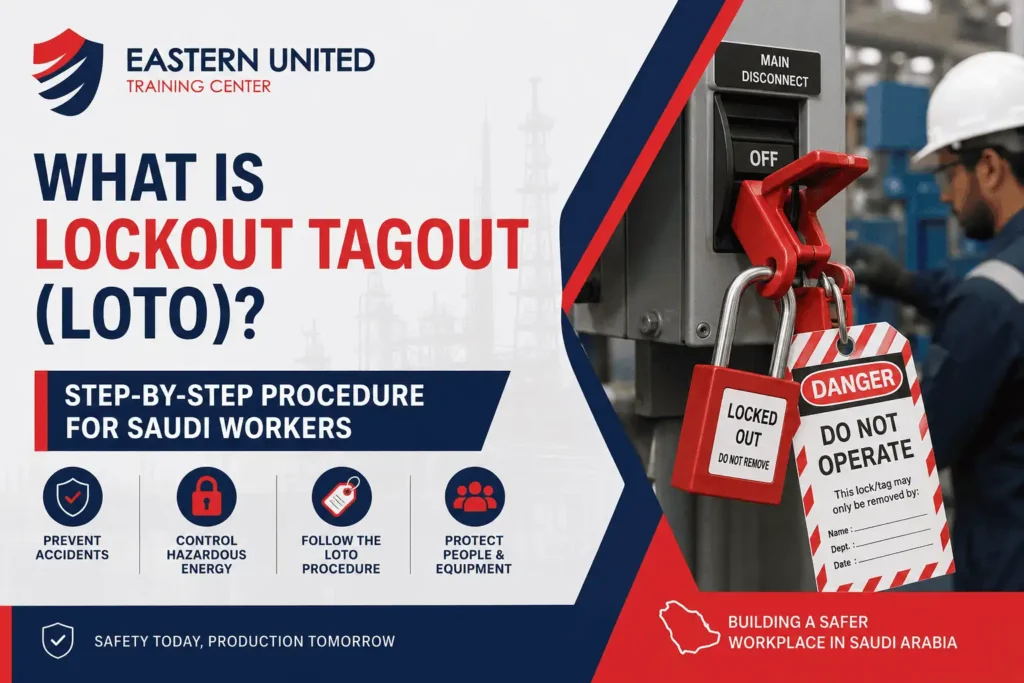
Lockout Tagout (LOTO) is a safety procedure that isolates equipment from all hazardous energy sources (electrical, mechanical, hydraulic, pneumatic, thermal, chemical, and gravitational) before maintenance or servicing begins. A lock physically holds the energy isolating device in the off position. A tag identifies the authorized employee who applied it and why the equipment must not be restarted. Together, they create a verified zero energy state: physical proof that no energy can reach the equipment while someone is working on it.
LOTO is governed internationally by OSHA 29 CFR 1910.147, which mandates written energy control procedures, trained authorized employees, and periodic audits. On Saudi Aramco facilities, the equivalent is GI 2.720 (Isolation and Lockout), which applies the same core principles within the Aramco Work Permit System under GI 2.710.
Why LOTO Matters on Saudi Industrial Sites
According to the International Labour Organization, over 2.3 million workers die from occupational accidents and work-related diseases every year globally. A significant proportion of those fatalities involve the unexpected release of hazardous energy during maintenance. That is exactly what LOTO is designed to prevent.
In Saudi Arabia’s oil, gas, and petrochemical sector, the risks are compounded. Equipment on these sites can hold multiple energy types simultaneously: an electric motor that drives a hydraulic pump connected to a pressurized pipeline at elevated temperature. Shutting off the power switch does not de-energize the system. Workers who skip or shortcut the LOTO procedure on such equipment are exposed to energies they cannot see or hear: pressurized fluid, stored spring tension, residual electricity in capacitors, or thermal energy in process lines.
OSHA data from the US indicates that roughly 120 workers die and 50,000 are injured annually from incidents involving hazardous energy control failures. On Saudi Aramco and SABIC sites, vendors and contractors are required to demonstrate LOTO competency through their Contractor HSE Program (CHSEP) before personnel are permitted to work on controlled equipment.
Seven Energy Types LOTO Controls
One of the most common errors workers make is assuming LOTO only applies to electrical power. Every authorized employee on a Saudi industrial site must be able to identify all of the following energy types before starting work:
| Energy Type | Examples on KSA Sites | Risk if Not Isolated |
|---|---|---|
| Electrical | Motors, control panels, capacitors, VFDs | Electrocution, arc flash |
| Mechanical | Rotating shafts, springs, flywheels, conveyor drives | Crush injury, amputation |
| Hydraulic | Pressurized cylinders, accumulators, fluid lines | Sudden movement, injection injury |
| Pneumatic | Compressed air lines, pneumatic actuators, instrument air | Projectile force, valve slam |
| Thermal | Steam lines, hot process piping, heat exchangers | Burns, scalding |
| Chemical | Residual hydrocarbons, H2S in pipelines, caustic agents | Toxic exposure, fire, explosion |
| Gravitational | Suspended loads, elevated machine parts, raised platforms | Crushing, fall of object |
On offshore and refinery turnarounds common in Jubail, Yanbu, and Ras Tanura, equipment routinely involves three to five of these energy types simultaneously. The LOTO procedure must account for all of them before any work begins.
Authorized vs Affected Employees: The Roles Every Saudi Crew Must Understand
Saudi Aramco GI 6.012 and OSHA 1910.147 both define three categories of personnel in any LOTO operation. Misunderstanding these roles causes the majority of real-world LOTO failures.
| Role | Who They Are | What They Must Do |
|---|---|---|
| Authorized Employee | The worker who performs the lockout and does the maintenance work | Apply their own lock, verify zero energy state, remove their own lock only |
| Affected Employee | An operator or worker who normally uses the equipment, or works in the area where lockout is in progress | Know the equipment is locked out, never attempt to restart it, report any tampered locks or tags |
| Other Employees | Anyone else working in the area who could inadvertently affect or be affected by the lockout | Understand that locked-out equipment must not be touched, energized, or operated |
The most critical rule: every authorized employee applies their own individual lock. A supervisor cannot lock out equipment on behalf of a crew. One worker, one lock, one key. On group lockout jobs (common on large Aramco turnarounds), each authorized employee clips their own lock onto a hasp at every isolation point. The equipment cannot be restarted until every lock is removed by the person who placed it.
The Step-by-Step LOTO Procedure for Saudi Workers
The following sequence follows OSHA 29 CFR 1910.147 and aligns with Saudi Aramco’s Lock, Tag, Clear and Try (LTCT) methodology used at Aramco-operated and Aramco-contracted facilities.
Step 1: Prepare and Identify All Energy Sources
Before touching the equipment, the authorized employee reviews the machine-specific LOTO procedure document. This document must list every energy source, every isolation point, and the specific method to control each one. Generic procedures that do not name the exact equipment are not compliant.
Preparation includes identifying: which circuit breakers, valves, or disconnects control this equipment; how many energy types are present; whether stored energy (pressure, spring tension, elevated loads) could remain after the power is removed; and whether a group hasp is needed because multiple workers will be on the job.
Step 2: Notify Affected Employees
Before shutting down, the authorized employee notifies all affected employees that the equipment is going out of service and why. On a Saudi Aramco site this notification typically happens as part of the Work Permit process under GI 2.710. The permit must be obtained before any LOTO begins.
Operators who normally use the equipment need to know the machine is isolated, when it went down, and who to contact. They must not attempt to restart it for any reason, including production pressure.
Step 3: Shut Down the Equipment
The authorized employee shuts the equipment down using its normal stopping procedure. The machine must reach a complete stop. Rotating parts must stop, conveyor belts must be stationary, pneumatic actuators must complete their cycle.
Do not attempt to lock out equipment while it is running. Shutdown comes first.
Step 4: Isolate All Energy Sources
This is the critical step most workers rush or do incompletely. Every energy source connected to the equipment must be physically isolated at its source, not just at the machine control panel.
For electrical energy: open the main disconnect and isolate at the panel, not just the local stop button. For hydraulic and pneumatic energy: close the supply valve at the header. For process pipelines: close and chain the block valve. For thermal energy: close steam supply and drain lines. For gravitational energy: lower suspended parts to a resting position or block them mechanically.
Every isolation point gets a lock and a tag.
Step 5: Apply Locks and Tags at Every Isolation Point
The authorized employee applies their personal lock to each energy isolating device. The tag must include the employee’s name, contact information, the date, and a statement that the device must not be operated.
Where multiple authorized employees are working on the same equipment, a group hasp is installed at each isolation point. Every worker clips their individual lock onto the group hasp. No single person controls access to the equipment. It remains locked until every worker has removed their personal lock.
On Saudi Aramco sites, locks are typically color-coded by department, and tags follow the format specified in GI 6.012. Contractors must use their own CHSEP-approved lock sets, not Aramco’s.
Step 6: Release or Restrain Stored Energy
After the locks are applied, the authorized employee must eliminate any residual energy that could still cause harm. This step is separate from isolation because energy can remain stored in a system even after all supply sources are blocked.
Bleed down pneumatic lines to atmospheric pressure. Drain hydraulic circuits and open bleeder valves. Discharge capacitors in electrical circuits using an approved bleed resistor. Block or lower suspended machine parts that could fall under gravity. Allow process equipment time to reach ambient temperature before entry.
Do not proceed to the next step until all stored energy has been released, blocked, or dissipated.
Step 7: Verify and Test for Zero Energy State (Lock, Tag, Clear and Try)
This is the final gate before work begins. The authorized employee verifies that the equipment is truly de-energized by attempting to operate it by pressing the start button, opening the control valve, or applying the operating control, while remaining clear of any moving parts or energy release points.
On Aramco sites, this step is called “Try” in the LTCT sequence: Lock, Tag, Clear, Try. If the machine does not start and no energy releases, the equipment is confirmed to be in a zero energy state and work can begin. If anything moves, trips, or energizes: stop. Return to isolation step and find what was missed.
A verification step without a physical Try is not complete LOTO.
Restoring Equipment After Maintenance
When the work is complete, LOTO removal follows a defined sequence, in reverse order and with equal care.
The authorized employee removes all tools, materials, and personnel from the work zone. Guards and safety devices are reinstalled. The employee notifies all affected employees that the equipment is about to be returned to service. Then, and only then, each authorized employee removes their own lock and tag from every isolation point. No other person is permitted to remove someone else’s lock except in a documented emergency procedure. Even then, it requires supervisor authorization and written record.
Energy is restored in the sequence specified in the LOTO procedure document. The machine is started and monitored to confirm normal operation.
LOTO on Saudi Aramco Multi-Contractor Turnarounds
On large maintenance turnarounds at Aramco refineries or SABIC plants, it is common for crews from multiple contractors to work on the same process unit simultaneously. This creates a group LOTO challenge that requires specific controls beyond single-worker procedures.
Each contractor provides its own trained authorized employees who apply their own locks. A facility-level isolation log tracks which equipment is under LOTO, by which contractor, for which scope of work. If Contractor A’s crew finishes and removes their locks but Contractor B’s crew is still working on the same system, the equipment cannot be restarted. Contractor B’s locks remain in place.
This is why LOTO training cannot be generic. Saudi workers and contractors on Aramco sites need training that covers the group lockout procedure, the Aramco-specific tagging format, and the interface with the GI 2.710 Work Permit system. A crew trained only on OSHA 1910.147 in a classroom in the US has not been trained for what they will encounter at Jubail Industrial City.
EUTC Global delivers LOTO training in Arabic and English at our Al Khobar centre and on-site at client facilities across the Kingdom, with content aligned to both OSHA 29 CFR 1910.147 and Saudi Aramco site requirements. This is part of our broader oil and gas safety training in Saudi Arabia program.
For facilities that also require confined space entry work during the same maintenance window, LOTO and confined space procedures often run in parallel. See our guide on the confined space entry permit process in Saudi Arabia for how these two procedures interact on site.
Frequently Asked Questions About LOTO in Saudi Arabia
What is the difference between lockout and tagout?
A lockout uses a physical device (typically a padlock) to hold an energy isolating device in the off or closed position. It physically prevents the equipment from being energized. A tagout uses a warning tag attached to an energy isolating device to tell others not to operate it, but without a physical lock. OSHA 1910.147 requires lockout wherever the energy isolating device can accept a lock. Tagout alone is only permitted when the equipment design physically prevents a lock from being attached, and additional protective measures must be documented in that case.
Does LOTO apply to all equipment on Saudi Aramco sites?
Yes. Saudi Aramco GI 2.720 requires isolation, lockout, and use of hold tags whenever personnel could be injured by unexpected release of energy or hazardous materials during maintenance or inspection. This applies to mechanical, electrical, hydraulic, and pneumatic systems, as well as process lines containing H2S, hydrocarbons, steam, and other hazardous materials.
Who needs LOTO training in Saudi Arabia?
Any worker classified as an authorized employee (someone who physically applies locks and performs maintenance) must complete formal LOTO training and demonstrate competency. Affected employees, those who operate or work near locked-out equipment, must receive awareness-level training on what a locked-out machine means and what they must not do. Contractors on Aramco and SABIC sites must show records of LOTO training as part of their CHSEP documentation.
Can a supervisor remove an employee’s lock if that employee is unavailable?
Standard procedure does not permit this. Only the authorized employee who applied a lock is permitted to remove it. If that worker is genuinely unavailable due to emergency, illness, or end of shift without a proper lockout transfer, the employer must follow a documented emergency removal procedure that requires supervisor authorization, confirmation that the original worker is not in the work area, and a written record of the removal. Aramco GI 6.012 addresses this in the context of emergency lock removal.
How long does LOTO training take?
A standard LOTO training course covers theoretical content and practical exercises. At EUTC Global, the course is delivered over one day for workers who need authorized employee certification, covering energy identification, procedure development, lock application, group lockout, and the Try step verification. Affected employee awareness training is typically a shorter session integrated into general safety induction programs.
What is the “Lock, Tag, Clear and Try” (LTCT) sequence?
LTCT is the four-step verification sequence used on Saudi Aramco sites. Lock: apply the lockout device at each energy isolation point. Tag: attach the approved tag with worker details. Clear: ensure all personnel are clear of the equipment and the work zone is safe. Try: attempt to operate the equipment using its normal controls to confirm zero energy state. Only after a successful Try (meaning the equipment does not respond) is the system confirmed safe for maintenance work to begin.
LOTO is among the mandatory HSE trainings for Aramco vendor companies required before crews can access controlled facilities. EUTC Global’s LOTO safety training program is available in Arabic and English, with classroom delivery in Al Khobar and on-site delivery anywhere in the Kingdom. Enrol in LOTO training at EUTC Global or contact us to arrange a corporate group session for your maintenance crew.