

Contents
- 1 What is the difference between ISO 9001 and ISO 22000?
- 2 ISO 9001 vs ISO 22000: side-by-side comparison
- 3 Which standard does your food business need in Saudi Arabia?
- 4 Why do many Saudi food businesses get both?
- 5 How to integrate ISO 9001 and ISO 22000 into one system
- 6 The Saudi Arabia context: SFDA, retailers, and export markets
- 7 Frequently asked questions
- 7.1 Do I need both ISO 9001 and ISO 22000 for my food business in Saudi Arabia?
- 7.2 Is ISO 22000 recognized by the SFDA in Saudi Arabia?
- 7.3 Which standard should a small food business in Saudi Arabia get first?
- 7.4 How long does it take to get ISO 22000 certified in Saudi Arabia?
- 7.5 Can ISO 9001 and ISO 22000 be audited together?
- 7.6 What is the difference between ISO 22000 and FSSC 22000?
- 8 Ready to certify your food business?
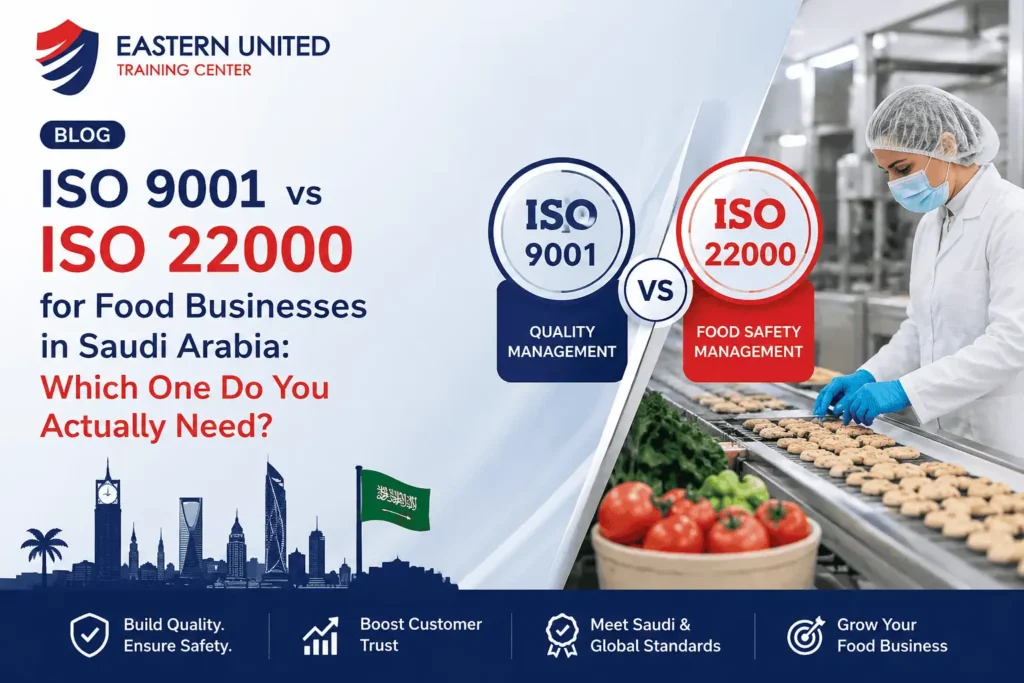
If you run a food business in Saudi Arabia and you are trying to figure out whether you need ISO 9001, ISO 22000, or both, here is the short answer. ISO 22000 is the food safety standard your business almost certainly needs, especially if you supply retailers, hotels, or government contracts. ISO 9001 is a quality management standard that improves how your whole business runs. Most established food companies in the Kingdom end up holding both, but the order you get them in, and whether you need both at all, depends on your customers and your stage of growth.
This guide breaks down the real difference between the two standards, which one fits your situation, and how Saudi-specific requirements like SFDA registration and major retailer demands should shape your decision.
What is the difference between ISO 9001 and ISO 22000?
ISO 9001 is a Quality Management System (QMS) standard that applies to any industry. It focuses on consistent product quality, customer satisfaction, and efficient processes. ISO 22000 is a Food Safety Management System (FSMS) standard built specifically for the food chain. It focuses on identifying and controlling food safety hazards, from raw material handling through to the consumer’s plate.
The simplest way to think about it: ISO 9001 makes sure your business delivers a consistent product. ISO 22000 makes sure that product is safe to eat. One is about quality, the other is about safety. They overlap in structure but solve different problems.
Both standards are published by the International Organization for Standardization, and both use the same Annex SL high-level structure. That shared structure is the reason they integrate so cleanly, which we explain further down.
ISO 9001 vs ISO 22000: side-by-side comparison
The table below shows where the two standards align and where they differ. This is the fastest way to see which one matches your needs.
| Feature | ISO 9001:2015 | ISO 22000:2018 |
|---|---|---|
| Full name | Quality Management System (QMS) | Food Safety Management System (FSMS) |
| Main focus | Product and service quality, customer satisfaction | Food safety and hazard control |
| Who it applies to | Any organization in any industry | Any organization in the food chain |
| Core methodology | Process approach, risk-based thinking | HACCP principles plus prerequisite programmes (PRPs) |
| Key risk focus | Risks to quality and customer outcomes | Food safety hazards: biological, chemical, physical, allergens |
| Structure | Annex SL (10 clauses) | Annex SL (10 clauses) |
| Saudi relevance | Government tenders, Aramco vendor pre-qualification, export credibility | SFDA recognition, retailer and hotel supply requirements, GCC export |
| Certification body audit | Stage 1 and Stage 2 | Stage 1 and Stage 2 |
| Best for | Improving overall operations and winning quality-focused contracts | Meeting food safety obligations and buyer requirements |
The biggest technical difference sits in clause 8 (Operation). In ISO 9001, clause 8 sets out a general framework for controlling quality across any process. In ISO 22000, clause 8 is where the food-specific requirements live: hazard analysis, critical control points, prerequisite programmes, and traceability. Everything outside clause 8 is broadly similar between the two standards, which is exactly why integrating them is so practical.
Which standard does your food business need in Saudi Arabia?
For most food businesses operating in the Kingdom, ISO 22000 is the priority because it directly addresses food safety, the area regulators and buyers scrutinize most. ISO 9001 becomes important when you want to strengthen overall operations, reduce waste, and qualify for quality-focused contracts. Your specific situation usually points clearly to one starting point.
Here is how the decision typically plays out for Saudi food businesses:
- You supply supermarkets, hotels, or catering contracts: ISO 22000 first. Major Saudi retailers and hospitality groups increasingly require food safety certification from suppliers. ISO 22000 is the standard they recognize.
- You need to satisfy an SFDA compliance requirement: ISO 22000 first. The Saudi Food and Drug Authority recognizes ISO 22000 as a structured food safety framework, which helps during inspections and registration.
- You are a food manufacturer planning to export across the GCC: ISO 22000 first, then consider FSSC 22000 for buyers who demand GFSI-recognized certification.
- You want to improve efficiency, reduce errors, and win larger contracts: ISO 9001 adds the quality layer on top of your food safety system.
- You are a large, established operation: both standards, implemented as one integrated system, give you the strongest position with regulators and buyers.
If your customers are not yet demanding food safety certification and you simply want better-run operations, starting with ISO 9001 is a reasonable first step. It builds the document control, internal audit, and corrective action habits that make adding ISO 22000 later much faster.
Why do many Saudi food businesses get both?
The two standards are complementary, not redundant. ISO 22000 keeps your food safe. ISO 9001 keeps your whole business consistent and efficient. Holding both signals to buyers, regulators, and partners that you manage quality and safety to a high standard, which matters in a competitive market like Saudi Arabia.
There is also a practical reason. Because both standards share the Annex SL structure, the management system elements outside food safety, things like document control, leadership, internal audits, and management review, are nearly identical. A food business that already holds ISO 9001 typically finds ISO 22000 faster and cheaper to add, because the management infrastructure is already in place. You are mostly adding the hazard analysis and critical control point elements in clause 8.
For Saudi food companies chasing larger contracts, this combination is becoming a baseline expectation rather than a competitive advantage. Government catering contracts, Aramco and SABIC site catering vendors, and major hotel groups often look for evidence of both quality and food safety management before they award business.
How to integrate ISO 9001 and ISO 22000 into one system
The most efficient approach for a food business that needs both is to implement them together as a single integrated management system, rather than certifying one and then bolting on the other. Because they share the same high-level structure, you build one set of management procedures and add food-specific controls where needed.
A practical integration sequence looks like this:
- Map your scope and decide on both standards from the start. Trying to retrofit ISO 9001 onto an existing ISO 22000 system, or vice versa, creates duplicated documentation.
- Build the shared management system elements once. Document control, leadership commitment, risk and opportunity planning, internal audits, and management review serve both standards.
- Run two layers of risk assessment. Process and quality risks for ISO 9001, and food safety hazards with critical control points for ISO 22000.
- Develop your prerequisite programmes and HACCP plan. This is the food-safety-specific core of ISO 22000 that ISO 9001 does not cover.
- Train staff on both their quality and food safety responsibilities. One training programme can cover both where roles overlap.
- Conduct combined internal audits. Auditing both systems in one pass reduces disruption and cost.
- Stage one certification audit covering both standards. Many certification bodies allow a combined audit, which saves time and audit fees.
Integrating from the start typically cuts the total certification timeline by 20 to 30 percent compared to certifying each standard separately. For Saudi food businesses with tight buyer deadlines, that difference is significant.
If you already run a HACCP system, you have a head start. Your existing hazard analysis and critical control point documentation can be migrated into the ISO 22000 structure first, then the ISO 9001 quality clauses layered on top. Our food safety and HACCP training in Saudi Arabia covers the hazard analysis foundation that underpins ISO 22000 certification.
The Saudi Arabia context: SFDA, retailers, and export markets
This is where the decision gets specific to the Kingdom, and where generic international guides fall short. Three Saudi-specific factors should shape your choice.
SFDA recognition. The Saudi Food and Drug Authority oversees food safety in the Kingdom. ISO 22000 provides a structured, internationally recognized food safety framework that aligns with SFDA expectations and supports your registration and inspection readiness. For food manufacturers, processors, and importers, this recognition carries real weight.
Retailer and hospitality demand. Major Saudi supermarket chains, hotel groups, and catering companies increasingly require food safety certification from their suppliers. If you want shelf space in large retailers or a supply contract with a hotel group, ISO 22000 is often a precondition rather than a bonus.
GCC and international export. If you plan to sell beyond Saudi Arabia into the wider Gulf or international markets, ISO 22000, and in many cases its FSSC 22000 extension recognized by the Global Food Safety Initiative, opens doors that domestic-only certification does not. Buyers in regulated markets expect GFSI-recognized food safety certification.
According to the Saudi Food and Drug Authority, food safety compliance is a core requirement for food establishments operating in the Kingdom, and structured management systems like ISO 22000 support that compliance. For businesses weighing the investment, our guide on how much ISO certification costs in Saudi Arabia breaks down the typical pricing factors.
If you are still deciding which standards to prioritize across your business, not just food safety, our comparison of ISO 9001 vs 14001 vs 45001 and which to get first is a useful companion read. And for the full consultation route, EUTC Global’s ISO certification consultation in Saudi Arabia covers ISO 9001, 14001, 45001, and 22000 end to end.
Frequently asked questions
Do I need both ISO 9001 and ISO 22000 for my food business in Saudi Arabia?
Not always. If your priority is meeting food safety requirements from SFDA, retailers, or hotel buyers, ISO 22000 alone may be enough to start. ISO 9001 adds a quality management layer that improves operations and helps win quality-focused contracts. Many established Saudi food businesses hold both, implemented as one integrated system, but smaller operations often begin with ISO 22000 and add ISO 9001 later.
Is ISO 22000 recognized by the SFDA in Saudi Arabia?
ISO 22000 is an internationally recognized food safety management framework that aligns with the expectations of the Saudi Food and Drug Authority. It integrates HACCP principles into a structured system, which supports SFDA registration and inspection readiness. It is widely held by food manufacturers, processors, and distributors operating in the Kingdom.
Which standard should a small food business in Saudi Arabia get first?
For most small food businesses, ISO 22000 should come first because it directly addresses the food safety requirements that customers and regulators care about most. ISO 9001 can be added later to strengthen overall quality management. If you already operate a HACCP system, you have a strong foundation for ISO 22000 certification.
How long does it take to get ISO 22000 certified in Saudi Arabia?
For a small to medium-sized food business with reasonably organized processes, ISO 22000 typically takes 3 to 4 months. Larger or multi-site operations may take 4 to 6 months. If you already hold ISO 9001 or run an established HACCP system, the timeline is usually shorter because the management infrastructure is already in place.
Can ISO 9001 and ISO 22000 be audited together?
Yes. Because both standards share the Annex SL high-level structure, many certification bodies offer a combined audit covering both standards in a single Stage 1 and Stage 2 process. This reduces audit time, cost, and disruption to your operations, which is why integrated implementation is the most efficient route for businesses that need both.
What is the difference between ISO 22000 and FSSC 22000?
ISO 22000 is the food safety management system standard. FSSC 22000 is a certification scheme built on ISO 22000 that adds sector-specific prerequisite programmes and is recognized by the Global Food Safety Initiative (GFSI). Some international and GCC buyers specifically require GFSI-recognized certification, in which case FSSC 22000 is the route to take.
Ready to certify your food business?
Choosing between ISO 9001 and ISO 22000, or implementing both, is easier with guidance from consultants who understand both the standards and the Saudi food sector. EUTC Global has helped food manufacturers, processors, and distributors across the Kingdom achieve certification and meet SFDA, retailer, and export requirements.
Enrol in ISO certification consultation at EUTC Global for a free scoping call, or explore our full ISO certification consultation services in Saudi Arabia to see how we guide food businesses from gap analysis to certification.