

Contents
- 1 What Is Aramco Vendor Pre-Qualification?
- 2 Does Aramco Require ISO 9001 Certification for Vendor Registration?
- 3 Why Is ISO 9001 Important for Aramco Suppliers?
- 4 How Does ISO 9001 Improve Aramco Supplier Approval Chances?
- 5 What Documents Are Required for Aramco Vendor Registration?
- 5.1 Legal and Company Documents
- 5.2 Financial Documentation
- 5.3 Quality Management System (ISO 9001) Documents
- 5.4 Technical Capability Documentation
- 5.5 Health, Safety and Environmental (HSE) Documentation
- 5.6 Category-Specific Requirements for Aramco Vendors
- 5.7 How Long Does ISO 9001 Certification Take in Saudi Arabia?
- 5.8 Standard ISO 9001 Certification Timeline
- 5.9 Factors That Speed Up ISO 9001 Certification in Saudi Arabia
- 5.10 Factors That Extend the Certification Timeline
- 6 Common Mistakes Saudi Suppliers Make During Aramco Pre-Qualification
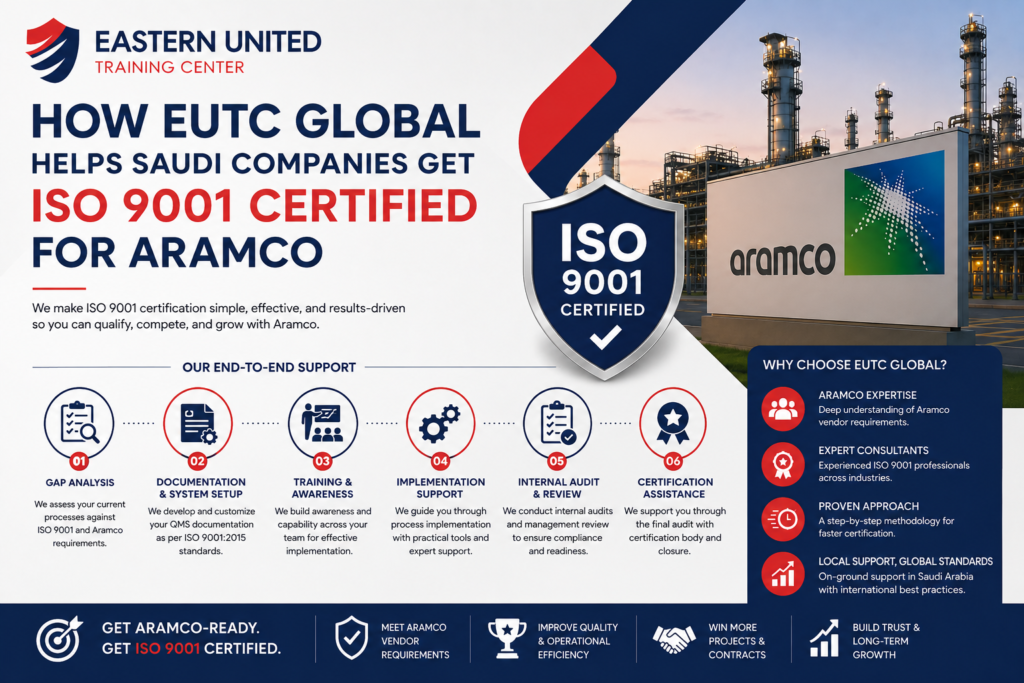
- 7 How EUTC Global Helps Saudi Companies Get ISO 9001 Certified for Aramco
- 8 EUTC Global’s Distinct Approach for Saudi Aramco Suppliers
- 8.1 Frequently Asked Questions
- 8.2 Is ISO 9001 Mandatory for Aramco Vendors?
- 8.3 Can Small Companies Apply for Aramco Supplier Registration?
- 8.4 How Much Does ISO 9001 Certification Cost in Saudi Arabia?
- 8.5 What Is the Difference Between Vendor Registration and Pre-Qualification?
- 8.6 How Long Is ISO 9001 Certification Valid?
- 9 Conclusion
Planning to become a Saudi Aramco supplier? Competitive pricing and technical capability alone are not enough. Aramco maintains strict vendor pre-qualification standards that require documented quality management systems. In Saudi Arabia’s procurement environment, ISO 9001 certification has become the baseline for operational credibility — and a practical requirement for most Aramco vendor categories.
This guide explains how ISO 9001 supports Aramco vendor registration, which documents you need, and how to avoid the most common mistakes that delay approval. Whether you run a fabrication company, maintenance operation, or industrial contracting business in Saudi Arabia, understanding these requirements can significantly improve your chances of becoming an approved Aramco vendor.
TL;DR: ISO 9001 is required for most Etimad tenders in Saudi Arabia (SGC Consulting, 2026). The Middle East and Africa ISO certification market reached USD 205.2 million in 2024, with projected annual growth of 14.7% through 2031 (Cognitive Market Research, 2026).
What Is Aramco Vendor Pre-Qualification?
Aramco vendor pre-qualification is a structured evaluation process that assesses whether your company meets the minimum standards to supply goods or services to Saudi Aramco. It checks your financial stability, technical capabilities, health and safety practices, quality management systems, and past performance records — all before you can bid on contracts or purchase orders.
This process is fundamentally different from simple vendor registration. Registration creates your profile in Aramco’s system. Pre-qualification involves detailed document submission, technical assessments, and often site visits that verify your actual operational capabilities.
Key Components Evaluated During Pre-Qualification
Aramco’s pre-qualification process reviews the following areas:
- Financial health — audited statements, bank guarantees, credit ratings
- Quality management systems — ISO 9001 or equivalent certification
- Health, safety, and environmental compliance — ISO 45001, ISO 14001
- Technical capacity and equipment availability
- Previous project experience in similar scope
- Workforce qualifications and training programs
- Insurance coverage and legal compliance
- Manufacturing or service delivery facilities
For specialized suppliers in fabrication, construction, or technical services, Aramco may require certifications beyond ISO 9001. ISO 19650 for BIM information management has become increasingly mandatory for projects over SAR 100 million under MOMRAH guidelines, often required alongside ISO 9001, ISO 45001, and ISO 14001 in pre-qualification criteria (SGC Consulting, 2026).
Pre-qualification status is typically valid for 2 to 3 years and requires renewal with updated documentation to maintain your approved vendor standing.
Does Aramco Require ISO 9001 Certification for Vendor Registration?
Yes. Aramco strongly favors ISO 9001 certification for vendor pre-qualification, and in many categories it is a mandatory requirement. While Aramco’s official documentation may describe ISO 9001 as “preferred” rather than explicitly mandatory for all vendor types, practical experience shows that applications without ISO 9001 face significant scoring disadvantages during technical evaluation.
Saudi Arabia’s procurement environment treats ISO certification as a necessity for most government and semi-government tenders submitted through the Etimad Platform. ISO 9001 and ISO 45001 appear in technical evaluation criteria across construction, healthcare, logistics, and services sectors (SGC Consulting, 2026).
When ISO 9001 Becomes Mandatory for Aramco Suppliers
Depending on your vendor category, ISO 9001 moves from strongly preferred to effectively required:
Manufacturing and fabrication suppliers: Mandatory for metal fabrication, equipment manufacturing, and component suppliers.
Construction contractors: Required alongside ISO 45001 for safety management systems.
Maintenance service providers: Expected for planned maintenance, facility management, and technical services.
Materials and supplies: Strongly preferred for high-value or critical materials.
Engineering and consulting services: Demonstrates systematic project management capabilities.
Even in categories where ISO 9001 is not explicitly listed as mandatory, certified competitors will score higher in technical evaluations. Aramco’s vendor assessment matrices allocate specific points for quality management systems, and ISO 9001 provides immediate third-party verification of those capabilities.
Key insight: Small and mid-sized Saudi suppliers often assume strong project references can substitute for ISO 9001. However, during Aramco’s technical scoring, non-certified companies regularly lose 10 to 15 evaluation points compared to ISO-certified competitors — enough to eliminate them from consideration even with competitive pricing.
Why Is ISO 9001 Important for Aramco Suppliers?
ISO 9001 certification demonstrates that your company operates with documented, consistent processes that minimize errors, reduce rework, and ensure customer satisfaction. For Aramco suppliers specifically, this translates to reduced project risk, fewer quality-related delays, and stronger contractual compliance.
The global ISO 9001 certificate count reached 1,479,165 in 2024 — a 76.7% increase from the prior year’s reported total of 837,049 (Oxebridge / ISO Survey 2024 Analysis, 2024). This growth reflects a broader recognition that quality management systems deliver real competitive advantages in global supply chains.
Documentation and Traceability Benefits
ISO 9001 creates standardized procedures for receiving specifications, processing orders, and delivering products. It establishes document control systems that Aramco auditors can review directly, along with complete traceability of materials, inspections, and quality records. Non-conformance tracking built into the system also demonstrates ongoing improvement — something Aramco’s assessors specifically look for.
Operational Consistency for Aramco Contract Performance
Certified companies maintain less variation in product quality across production batches. Systematic staff training programs maintain competence levels. Preventive maintenance schedules minimize equipment-related defects. Supplier management processes ensure consistent incoming material quality. These aren’t abstract benefits — they directly reduce the likelihood of quality rejections, delivery delays, and inspection hold-ups at Aramco receiving facilities.
A Saudi fabrication company supplying structural steel to Aramco projects reported a 40% reduction in rework costs within the first year of ISO 9001 implementation. Their systematic inspection procedures caught dimensional errors before welding operations, preventing expensive corrections later in production.
Audit Readiness for Aramco Assessments
ISO 9001 builds the infrastructure Aramco auditors expect to find. This includes established quality records, internal audit systems that identify issues before external assessments, management review processes showing leadership commitment, and corrective action procedures aligned with Aramco’s expectations. Companies with functioning ISO 9001 systems face far fewer surprises during Aramco’s vendor assessments.
Risk Management Capabilities
The standard requires systematic identification of potential quality issues before they affect deliverables. Risk-based thinking is applied to critical processes. Contingency planning covers equipment failures, supplier disruptions, and resource constraints. This structured approach to risk directly addresses what Aramco needs from its supplier base.
How Does ISO 9001 Improve Aramco Supplier Approval Chances?
ISO 9001 certification provides objective, third-party verified proof of your quality management capabilities. This directly addresses multiple evaluation criteria in Aramco’s vendor assessment process and removes the guesswork that slows down applications without certification.
Technical Scoring Improvements
ISO 9001 delivers immediate points in quality management system evaluation sections of Aramco’s scoring matrix. It strengthens the credibility of past project documentation, improves your position during comparative assessments, and aligns your systems with Aramco’s own quality standards and procedures. These are not marginal advantages — they consistently separate approved vendors from rejected ones.
Faster Application Processing
Certified companies face fewer documentation requests from Aramco’s vendor assessment team. Desktop reviews move faster when quality procedures are already documented and verified by a third party. The probability of approval without requiring a facility site visit increases significantly. Two companies applying in the same category — one ISO 9001 certified, one relying on self-described quality practices — will experience dramatically different timelines. Documented cases show differences of 4 months versus 11 months for conditional approval.
Category Expansion Opportunities
Once approved, ISO 9001 certification simplifies the process of qualifying for additional product or service categories. It positions you for higher-value contract opportunities and reduces administrative friction when adding new capabilities to your vendor profile.
Improved Contract Performance After Approval
ISO-certified suppliers experience fewer delivery delays due to quality rejections, reduced inspection hold-ups at Aramco receiving facilities, clearer communication through documented interfaces and responsibilities, and stronger working relationships with Aramco’s quality and procurement teams.
Key insight: Many Saudi suppliers treat ISO 9001 as a checkbox for Aramco registration. Companies that genuinely implement the standard — rather than simply obtaining the certificate — consistently perform better during contract execution. This leads to preferred supplier status and direct award opportunities worth significantly more than the certification investment.
What Documents Are Required for Aramco Vendor Registration?
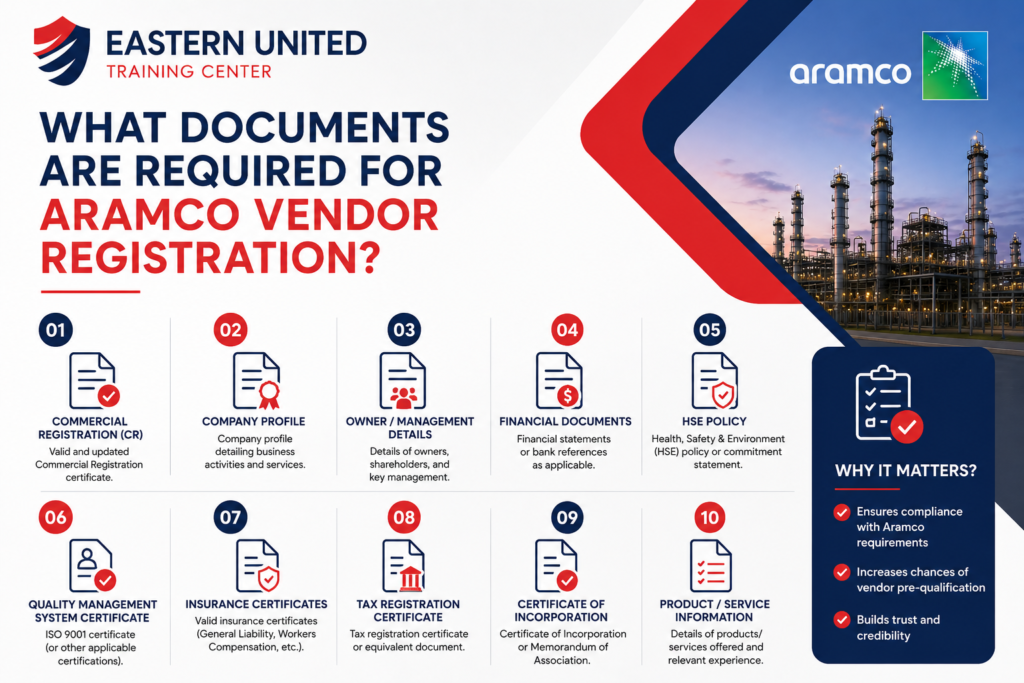
Aramco vendor registration requires complete documentation covering legal, financial, technical, and quality management aspects of your business. ISO 9001 certification significantly simplifies the quality-related documentation section because your quality manual already addresses most of what Aramco requires.
Legal and Company Documents
- Commercial registration certificate (current and valid)
- Chamber of Commerce membership certificate
- GOSI registration certificate
- Zakat and income tax certificates
- Company profile with ownership structure
- Articles of association or partnership agreements
- Authorized signatory documentation
Financial Documentation
- Audited financial statements for the last 3 years
- Bank reference letters and credit facility confirmations
- Professional liability insurance certificates
- Performance bond capability documentation
- Financial ratios demonstrating stability and capacity
Quality Management System (ISO 9001) Documents
- ISO 9001 certificate — current, valid, and with scope matching your vendor category
- Quality manual detailing your QMS scope and processes
- Documented procedures for key operations
- Calibration certificates for inspection and test equipment
- Internal audit records demonstrating system effectiveness
- Management review meeting minutes
- List of controlled documents and procedures
Technical Capability Documentation
- Major equipment and machinery list with specifications
- Manufacturing or service facility descriptions
- Workforce qualifications and training records
- Organizational chart showing key technical positions
- Project experience list with verifiable client references
- Technical licenses or specialized certifications
- Product samples or service delivery examples (category dependent)
Health, Safety and Environmental (HSE) Documentation
- ISO 45001 certificate where your category requires it
- ISO 14001 certificate for manufacturing and industrial services
- Safety policies and emergency response procedures
- Environmental management practices
- Incident and accident records
- Safety training programs
Category-Specific Requirements for Aramco Vendors
Fabrication Companies
- Welding procedure specifications (WPS) and procedure qualification records (PQR)
- Welder qualification certificates
- Material traceability procedures
- Non-destructive testing (NDT) capabilities and certifications
- Quality control plans for typical products
Maintenance Service Providers
- Preventive maintenance program examples
- Spare parts management systems
- Emergency response capabilities and response times
- Technician certification records
- Maintenance management software documentation
Materials Suppliers
- Manufacturer authorizations and distributor agreements
- Product certification and test reports
- Material safety data sheets (MSDS)
- Warehouse and storage facility documentation
- Inventory management systems
Companies with ISO 9001 certification can reference their quality manual for most process-related documentation, eliminating the need to create separate documents specifically for Aramco registration. This saves considerable time and ensures consistency across all submitted materials.
How Long Does ISO 9001 Certification Take in Saudi Arabia?
The ISO 9001 certification timeline in Saudi Arabia typically spans 3 to 6 months for companies with established operations. This varies based on your current documentation status, organizational complexity, and certification body availability. Understanding this timeline is essential for planning your Aramco vendor registration strategy.
For context, India’s ISO 9001 certificate count grew from 57,658 in 2023 to 95,007 in 2024 — a 39% year-over-year increase (Oxebridge / ISO Survey 2024 Analysis, 2024). This reflects streamlined certification processes and rising business demand for quality management systems across developing markets, including Saudi Arabia.
Standard ISO 9001 Certification Timeline
Phase 1 — Gap Analysis and Preparation (4 to 6 Weeks)
Initial assessment of existing quality management practices, identification of missing procedures and documentation, development or revision of your quality manual, creation of required documented procedures, staff training on new or updated processes, and implementation of document control systems.
Pase 2 — System Implementation (6 to 8 Weeks)
Full deployment of documented procedures across operations, internal auditor training and first internal audit, collection of objective evidence for system effectiveness, management review meeting to assess system performance, corrective actions for identified non-conformances, and practice runs of key processes with documentation.
Phase 3 — Certification Audit (2 to 4 Weeks)
Stage 1 audit covering documentation review and readiness assessment, addressing any Stage 1 findings before proceeding, Stage 2 on-site verification of implementation, corrective action responses for any non-conformances, then certification decision and certificate issuance.
Factors That Speed Up ISO 9001 Certification in Saudi Arabia
- Existing documentation from previous quality initiatives
- Experienced quality manager or coordinator already on staff
- Small to medium company size with straightforward processes
- Single location rather than multiple facilities
- Working with a knowledgeable ISO certification consultant familiar with Saudi business practices
- Clear management commitment and adequate resource allocation
Factors That Extend the Certification Timeline
- Starting with minimal or no existing documentation
- Complex multi-site operations
- High staff turnover during implementation
- Limited management engagement or competing organizational priorities
- Need for significant process improvements before certification is viable
- Delays in scheduling certification body audits
Practical guidance: For companies targeting Aramco vendor registration, begin ISO 9001 certification at least 6 months before your planned application submission date. This provides buffer for unexpected challenges and ensures your certificate is fully issued — not just in process — when Aramco reviews your application.
Common Mistakes Saudi Suppliers Make During Aramco Pre-Qualification
Saudi companies frequently make avoidable errors during Aramco vendor pre-qualification that delay approval or result in outright rejection. Understanding these pitfalls helps you build a stronger application that moves through the assessment process without unnecessary hold-ups.
Documentation and Certification Mistakes
Submitting expired or suspended certificates: ISO 9001 certificates must be current at submission. Suspension due to missed surveillance audits disqualifies applications immediately. Certificates must show a scope that matches your vendor category, with visible and legitimate accreditation body logos.
Incomplete quality management documentation: Missing mandatory ISO 9001 procedures, a quality manual that does not address Aramco-relevant processes, no implementation evidence such as records, forms, and reports, or internal audit records older than 12 months all signal an inactive system to Aramco’s assessors.
Inconsistent information across documents: Company name variations between commercial registration and ISO certificate, different facility addresses in legal documents versus quality manual, organizational charts that do not match actual operations, and equipment lists that contradict technical capability claims are all common rejection triggers.
Technical Capability Errors
Overstating capabilities: Listing equipment you do not own, claiming certifications not actually held, including project experience from previous employment or partnerships without disclosure, and exaggerating workforce size or qualification levels are serious issues. Aramco verifies these claims, and discrepancies damage credibility permanently.
Poor project reference quality: References without verifiable contact information, projects outside your application category, work completed more than 5 years ago without recent examples, and joint venture projects where your company’s specific role is not documented all weaken your technical case significantly.
Financial Documentation Problems
Weak financial position presentation: Unaudited statements for companies above the threshold, financial statements older than 18 months, negative working capital or poor liquidity ratios without explanation, and missing or qualified auditor notes create red flags that trigger additional scrutiny.
Insufficient insurance coverage: Policy limits below Aramco’s minimum requirements, certificates that do not clearly show coverage types, missing endorsements for specific risk categories, and expired policies or coverage gaps all lead to rejection or conditional approval with restrictions.
Process and Timing Mistakes
Starting too late: Beginning ISO 9001 certification only when you decide to apply, failing to allow adequate time for document preparation, rushing submissions with incomplete attachments, and missing Aramco’s specific submission windows for certain categories are among the most costly mistakes suppliers make.
Failing to maintain active registration: Not renewing certificates before expiry, ignoring requests for additional information or clarification, missing deadlines for supplementary documentation, and allowing your vendor profile to become inactive through inattention all put approved status at risk.
A maintenance company submitted their Aramco application with what appeared to be a valid ISO 9001 certificate. However, they had missed their annual surveillance audit deadline, and their certification body had suspended the certificate two weeks before submission. Aramco’s verification process caught this, resulting in immediate rejection. The company had to complete the surveillance audit, restore the certificate, and reapply — costing six months and a significant contract opportunity.
Key insight: The most expensive mistake is treating Aramco vendor registration as a one-time paperwork exercise. It requires continuous commitment to consistent compliance. Suppliers who maintain active quality management systems, keep certifications current, and regularly update their vendor profiles consistently win more contracts and face fewer compliance issues during execution.
How EUTC Global Helps Saudi Companies Get ISO 9001 Certified for Aramco
EUTC Global provides comprehensive ISO certification support specifically for Saudi companies pursuing Aramco vendor registration and government tenders in the Kingdom. Their approach combines international quality management expertise with practical knowledge of Saudi business environments and Aramco’s specific pre-qualification requirements.
Tailored ISO 9001 Certification Support Services
Initial gap analysis and planning: Detailed assessment of current quality management practices, identification of specific gaps relative to ISO 9001 requirements, a customized implementation roadmap aligned with your Aramco application timeline, resource and budget planning for the certification investment.
Documentation development: Quality manual creation tailored to your operations and scope, documented procedures addressing ISO 9001 mandatory requirements, forms, checklists, and templates for day-to-day quality management, documentation control systems suited to your company size, and integration with existing business systems.
Implementation support: On-site guidance during system deployment, staff training on quality management principles and procedures, internal auditor training for ongoing system maintenance, management review facilitation, and objective evidence collection and record-keeping systems.
Audit preparation and support: Pre-audit assessments to identify potential non-conformances, corrective action development for identified gaps, mock audits simulating certification body assessments, audit day coordination, and post-audit corrective action assistance.
Aramco-specific preparation: Alignment of quality manual with Aramco vendor requirements, document packaging for vendor registration applications, technical capability documentation support, category-specific requirement guidance, and vendor portal navigation assistance.
EUTC Global’s Distinct Approach for Saudi Aramco Suppliers
Industry-specific expertise: EUTC Global works extensively with fabrication companies, maintenance providers, construction contractors, and industrial suppliers — the primary vendor categories for Aramco. This specialization means practical quality management systems that improve actual performance, not just earn a certificate.
Saudi regulatory knowledge: Beyond ISO 9001, EUTC Global helps companies navigate MOMRAH guidelines, Saudi Building Code compliance, and integration with additional certifications commonly required for government bids in Saudi Arabia.
Post-certification support: Unlike consultants who disengage after certificate issuance, EUTC Global provides ongoing support for surveillance audits, system improvements, and additional certifications as your business grows and pursues larger Aramco opportunities.
The Middle East and Africa ISO certification market was valued at USD 205.2 million in 2024 and is projected to grow at 14.7% CAGR through 2031 (Cognitive Market Research, 2026). This growth reflects rising demand for professional certification support that ensures first-attempt success and genuine system implementation.
A Dammam-based fabrication company engaged EUTC Global in March to achieve ISO 9001 certification before a June Aramco tender deadline. EUTC Global completed a rapid gap analysis, identified critical documentation gaps, and implemented a focused quality management system over 10 weeks. The company achieved certification in late May, submitted their vendor application in June, and won their first direct Aramco contract in September — a SAR 18 million award.
For small to medium Saudi companies, professional certification support is typically more cost-effective than internal development. Faster certification, fewer audit non-conformances, and a higher contract win rate consistently justify the investment in expert guidance.
Frequently Asked Questions
Is ISO 9001 Mandatory for Aramco Vendors?
ISO 9001 is not technically mandatory for every Aramco vendor category, but it is practically required for most. Saudi Arabia’s procurement environment treats ISO certification as a baseline requirement. ISO 9001 and ISO 45001 appear in technical evaluation criteria across construction, healthcare, logistics, and services sectors (SGC Consulting, 2026). Applications without ISO 9001 consistently score lower during technical assessments, greatly reducing approval chances even when pricing and experience are competitive.
Can Small Companies Apply for Aramco Supplier Registration?
Yes. Small companies regularly achieve approved vendor status in specialized Aramco categories. Aramco does not set minimum company size requirements for most vendor types. What matters is demonstrating sufficient financial capacity, technical capability, and appropriate quality management systems for your proposed scope of work. ISO 9001 certification is particularly valuable for smaller companies because it provides objective third-party credibility that compensates for less extensive project history.
How Much Does ISO 9001 Certification Cost in Saudi Arabia?
ISO 9001 certification in Saudi Arabia generally ranges from SAR 25,000 to SAR 75,000 for small to medium companies, covering consultant fees, certification body audit fees, and internal implementation costs. Companies with 10 to 50 employees typically invest SAR 30,000 to SAR 45,000. Larger operations with multiple sites or complex processes may reach SAR 100,000 or more. China held 651,851 ISO 9001 certificates in 2024 — the highest total worldwide (Oxebridge / ISO Survey 2024 Analysis, 2024) — demonstrating that certification scales appropriately for businesses of all sizes.
What Is the Difference Between Vendor Registration and Pre-Qualification?
Vendor registration creates your basic company profile in Aramco’s supplier database. It is an administrative process requiring minimal documentation such as commercial registration and contact information. Vendor pre-qualification is the detailed assessment that determines whether you can actually supply goods or services to Aramco. It requires comprehensive financial, technical, quality management, and safety documentation. Registration takes weeks; pre-qualification takes months and requires certifications like ISO 9001. You must complete registration before pre-qualification, but registration alone does not permit you to bid on contracts.
How Long Is ISO 9001 Certification Valid?
ISO 9001 certification is valid for three years from the issue date, subject to successful annual surveillance audits. Certification bodies conduct surveillance audits approximately every 12 months to verify your quality management system remains effective and compliant. After three years, a recertification audit similar in scope to the initial certification renews your certificate for another three-year cycle. The United Kingdom held 32,988 ISO 9001 certificates in 2024 (Oxebridge / ISO Survey 2024 Analysis, 2024), reflecting mature certification maintenance practices. Missing surveillance audits results in certificate suspension, which disqualifies your Aramco vendor status until the certificate is restored.
Conclusion
ISO 9001 certification has become a core requirement for successful Aramco vendor pre-qualification in Saudi Arabia. It provides the documented quality management systems Aramco requires and delivers measurable competitive advantages during technical evaluation. The investment of time and resources in certification pays dividends well beyond vendor approval — companies consistently report lower rework costs, better operational consistency, and stronger positioning for high-value contracts.
Key takeaways for Saudi suppliers pursuing Aramco vendor status:
- Begin ISO 9001 certification at least 6 months before your planned Aramco application submission date
- ISO 9001 directly addresses multiple evaluation criteria in Aramco’s vendor assessment process
- Professional certification support from experienced consultants accelerates the process and improves first-attempt success rates
- Maintain active certification through annual surveillance audits — never allow it to lapse
- Combine ISO 9001 with ISO 45001 and ISO 14001 for a stronger competitive position across more categories
- Focus on genuine implementation rather than minimum compliance — the operational benefits justify the investment independently of procurement advantages
- Keep vendor registration documents current and respond promptly to all Aramco requests
- Plan for category expansion opportunities once your initial vendor approval is secured
The Middle East ISO certification market is projected to grow at 14.7% annually through 2031, reflecting a broader recognition that quality management systems deliver tangible business advantages beyond procurement requirements. For Saudi companies serious about becoming Aramco suppliers, ISO 9001 certification is not a checkbox. It is the foundation for consistent growth and long-term success in the Kingdom’s expanding industrial sector.