

Contents
- 1 Why ISO Certification Matters for Saudi Businesses Under Vision 2030
- 2 How ISO Certification Helps Win Government and Corporate Contracts
- 3 Operational Efficiency, Risk Management, and Bottom-Line Benefits
- 4 Common ISO Standards Used in Saudi Arabia
- 5 Cost vs. Long-Term Business Benefits
- 6 Frequently Asked Questions
- 7 Conclusion
ISO Certification helps Saudi businesses unlock government contracts, build customer trust, and streamline operations. As Vision 2030 transforms the Kingdom’s economy, companies across manufacturing, construction, healthcare, and oil & gas are adopting ISO Certification In Saudi Arabia to meet stringent prequalification requirements and enhance market competitiveness.
ISO certification is no longer merely a compliance checkbox. It has become a strategic business tool. Saudi organizations are finding that internationally recognized quality, environmental, and safety standards provide access to both government tenders and private sector opportunities. From Aramco contracts to Etimad platform eligibility, ISO standards have become the foundation for conducting business in the Kingdom.
Whether you run a small to medium-sized enterprise (SME) or manage a large organization, understanding how ISO certification affects your financial results is important. This article breaks down the concrete benefits, addresses common questions, and explains why businesses are increasingly seeking ISO Consultants In Saudi Arabia for implementation support.
TL;DR: ISO certification in Saudi Arabia delivers direct business value through improved tender eligibility, operational efficiency, and customer confidence. ISO 9001:2015 is required for most Etimad tenders, making certification essential for government contracts (SGC Consulting, 2026).
Why ISO Certification Matters for Saudi Businesses Under Vision 2030
ISO certification supports Saudi Arabia’s Vision 2030 by improving quality, compliance, and global competitiveness for businesses operating in the Kingdom (Intermax Consultancy, 2024). The government’s economic transformation agenda highlights international standards as a path to diversification and excellence.
Saudi businesses face increasing pressure to demonstrate quality management, environmental responsibility, and occupational safety. The importance of ISO standards is particularly high currently.
Alignment with National Priorities:
- Vision 2030 emphasizes world-class business practices.
- Government procurement favors certified suppliers.
- International partnerships require recognized standards.
- Export markets demand ISO compliance.
Regulatory Environment:
- SASO (Saudi Standards, Metrology and Quality Organization) promotes ISO adoption.
- The Ministry of Commerce encourages certification for SME growth.
- Industry-specific regulators reference ISO frameworks.
- Municipal and provincial authorities prioritize certified contractors.
ISO certification in Saudi Arabia is increasingly treated as a business development prerequisite rather than just a compliance exercise, especially across construction, oil and gas, healthcare, logistics, and IT (SGC Consulting, 2026).
Our insight: Companies that delay pursuing ISO certification often find themselves excluded from tender opportunities. Early adoption creates a competitive position that is difficult for rivals to match.
How ISO Certification Helps Win Government and Corporate Contracts
ISO 9001, ISO 45001, and ISO 14001 consistently appear in prequalification requirements for Saudi projects and contracts (SGC Consulting, 2026). This is not by chance. Government entities and major corporations use ISO certification as a risk management filter.
Etimad and Government Procurement:
ISO 9001:2015 is cited as the basic quality-management standard for all sectors and is required for most Etimad tenders in Saudi Arabia (SGC Consulting, 2026). Without this certification, your company simply cannot bid for many government opportunities.
The Etimad platform, Saudi Arabia’s unified procurement system, explicitly lists ISO requirements in tender specifications. Companies without active certification face automatic disqualification.
Aramco and Major Contractors:
- ISO 9001 (Quality Management) is mandatory for most suppliers.
- ISO 45001 (Occupational Health & Safety) is required for construction and field services.
- ISO 14001 (Environmental Management) is increasingly expected.
- ISO 27001 (Information Security) is essential for IT providers.Private Sector Advantages:
- Enhanced credibility with multinational clients.
- Preferred vendor status with major corporations.
- Simplified due diligence processes.
- Access to supply chain partnerships.
ISO certification can deliver direct financial returns for SMEs through improved tender eligibility alone in Saudi Arabia (SGC Consulting, 2026). That’s not abstract value; it’s measurable revenue impact.
Operational Efficiency, Risk Management, and Bottom-Line Benefits
Saudi organizations that maintain active ISO certification gain eligibility support for government and private contracts, alongside improved customer confidence and operational efficiency (SecureLink SA, 2026). However, financial benefits extend beyond contract access.
Cost Reduction Through Process Optimization:
- Reduced waste and rework.
- Lower insurance premiums (especially with ISO 45001).
- Decreased incident costs.
- Improved resource utilization.
- Streamlined documentation.
ISO certification is associated with increased profit potential and market share, improved operational efficiency, and access to global markets as core business benefits (QCertify Global, 2024).
Risk Mitigation:
- Systematic hazard identification (ISO 45001).
- Data breach prevention (ISO 27001).
- Environmental compliance (ISO 14001).
- Quality failure reduction (ISO 9001).
- Regulatory violation avoidance.
Employee Performance Improvements:
Clear procedures and defined responsibilities transform workplace performance. ISO standards create accountability frameworks that employees understand and follow.
- Reduced training time for new hires.
- Consistent service delivery.
- Better communication across departments.
- Enhanced problem-solving abilities.
- Lower staff turnover through improved workplace safety.
Customer Trust and Market Reputation:
ISO certification in Saudi Arabia is described as a key factor in helping businesses gain trust, improve efficiency, and increase customer satisfaction (LinkedIn Pulse, 2024).
International buyers, especially from European and North American markets, often require ISO certification before establishing partnerships. For exporters, it’s essential.
Our insight: The certification process itself uncovers operational weaknesses that companies were previously unaware of. Organizations report that a gap analysis during ISO implementation helps identify issues that were costing them thousands monthly.
Common ISO Standards Used in Saudi Arabia
Different industries prioritize different ISO standards. Understanding which certifications matter for your sector helps you make sound investments.
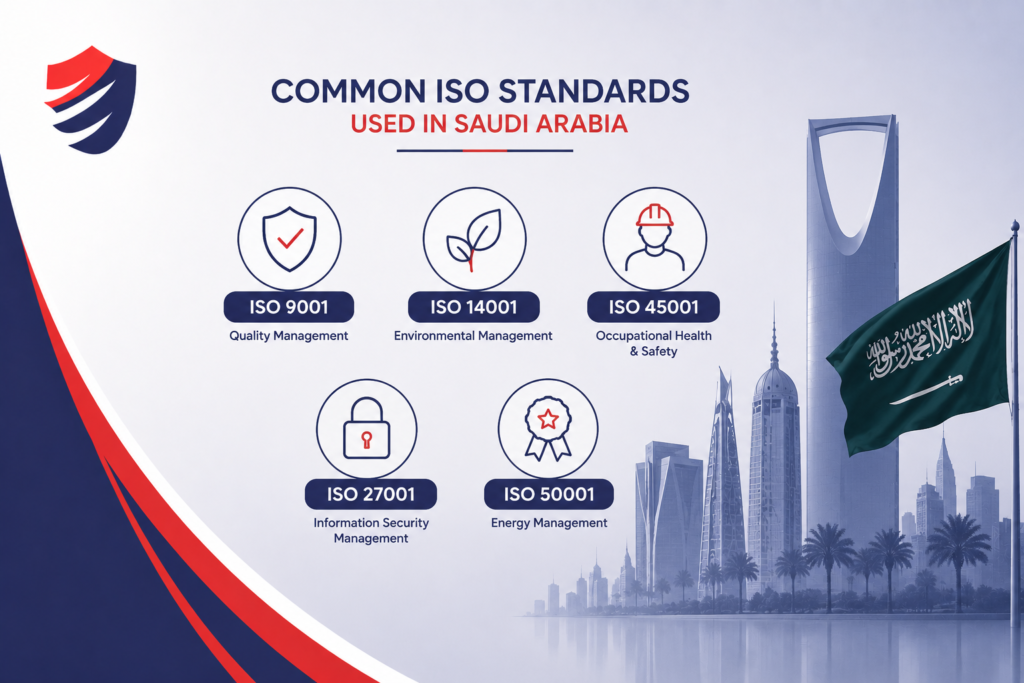
ISO 9001 – Quality Management System:
- Most widely recognized globally.
- Applicable to all business types.
- A foundation for other ISO certifications.
- Mandatory for most government tenders.
ISO 45001 – Occupational Health & Safety:
- Essential for construction companies.
- Required by oil & gas contractors.
- Reduces workplace accidents and liability.
- Demonstrates duty of care toward employees.
ISO 14001 – Environmental Management System:
- Growing importance with the Saudi Green Initiative.
- Required for projects with environmental impact.
- Helps manage waste, emissions, and resource use.
- Supports sustainability reporting.
ISO 27001 – Information Security Management:
ISO 27001 certification has become a de facto requirement in many government procurement processes for IT service providers in Saudi Arabia (SGC Consulting, 2026).
With increasing digitization, data protection is non-negotiable. Government entities will not trust IT vendors without this certification.
ISO 26000 – Social Responsibility:
ISO 26000 adoption is associated with improved reputation, increased stakeholder trust, and competitive advantage in Gulf markets, including Saudi Arabia (SGS, 2025). While not certifiable, this standard guides ethical business practices.
Industry-Specific Standards:
- ISO 13485 for medical device manufacturers.
- ISO 22000 for food safety.
- ISO 50001 for energy management.
- ISO 17025 for testing laboratories.
Cost vs. Long-Term Business Benefits
Let’s address the investment required for ISO certification. Is it worth it?
Typical Costs Include:
- Consultant fees (if using external support).
- Internal resource allocation.
- Documentation development.
- Training programs.
- Certification audit fees.
- Annual surveillance audits.
For SMEs, the total investment for ISO 9001 certification typically ranges from SAR 30,000 to SAR 80,000, depending on company size and complexity.
Return on Investment:
The payback period is surprisingly short. Consider these factors:
- A single government contract can exceed the entire certification cost.
- Reduced operational costs compound annually.
- Lower insurance premiums continue indefinitely.
- An enhanced reputation attracts premium clients.
- Export opportunities significantly increase revenue streams.
Businesses collaborating with experienced consultants like EUTC Global can streamline the process. This reduces time-to-certification and minimizes disruption to daily operations.
Eastren United Training Center specializes in helping Saudi businesses navigate the certification process efficiently. They offer consulting and training services tailored to local market requirements.
Frequently Asked Questions
How long does ISO certification take in Saudi Arabia?
Most companies complete ISO 9001 certification within 4-6 months when working with qualified consultants. The timeline depends on your current documentation, company size, and complexity. Organizations with established quality systems can sometimes achieve certification in 3 months, while complex enterprises might need 9-12 months. The key is maintaining progress throughout implementation.
Is ISO certification mandatory in Saudi Arabia?
ISO certification isn’t legally mandatory for all businesses, but it’s often a functional requirement for companies pursuing government contracts, Aramco projects, or international partnerships. ISO 9001 is required for most Etimad tenders (SGC Consulting, 2026), making it essential for businesses targeting public sector opportunities.
Can small businesses afford ISO certification?
Yes. ISO certification can deliver a direct financial return for SMEs through improved tender eligibility alone (SGC Consulting, 2026). Many certification bodies offer scaled pricing based on employee count. Government support programs and business development incentives sometimes subsidize certification costs for qualifying SMEs.
What’s the difference between ISO 9001 and other ISO standards?
ISO 9001 focuses specifically on quality management systems and general business processes. Other standards address specialized areas: ISO 45001 covers workplace safety, ISO 14001 handles environmental management, and ISO 27001 manages information security. Many companies pursue multiple certifications as their operations expand and contract requirements evolve.
Do I need a consultant for ISO certification?
While not mandatory, consultants significantly reduce implementation time and improve first-audit pass rates. Experienced ISO consultants in Saudi Arabia understand local regulatory requirements, auditor expectations, and industry-specific nuances. They help avoid common mistakes that delay certification or result in non-conformities.
Conclusion
ISO certification has changed from a desirable credential into a business necessity for Saudi companies. Whether you’re targeting government contracts, expanding into export markets, or simply improving operational efficiency, the benefits far outweigh the investment.
Key Takeaways:
- ISO 9001 is required for most Etimad government tenders in Saudi Arabia.
- Certification directly impacts tender eligibility and contract access.
- Vision 2030 initiatives are accelerating ISO adoption across all sectors.
- Operational improvements often deliver cost savings that exceed certification expenses.
- Multiple ISO standards (9001, 45001, 14001, 27001) address different business needs.
- Early certification creates competitive advantages that build over time.
The certification journey might seem overwhelming, but you don’t have to navigate it alone. EUTC Global provides comprehensive ISO certification support specifically for Saudi businesses. From gap analysis to final certification, their team guides you through every step.
Ready to unlock new business opportunities through ISO certification? Contact EUTC Global today to discuss your certification needs and receive a customized implementation roadmap. Their expertise in Saudi market requirements ensures a smooth, efficient path to certification that minimizes disruption while maximizing business value.
Don’t let a lack of certification prevent you from competing for the contracts your company deserves. Start your ISO journey now and position your business for sustainable growth in Saudi Arabia’s changing economy.