

Contents
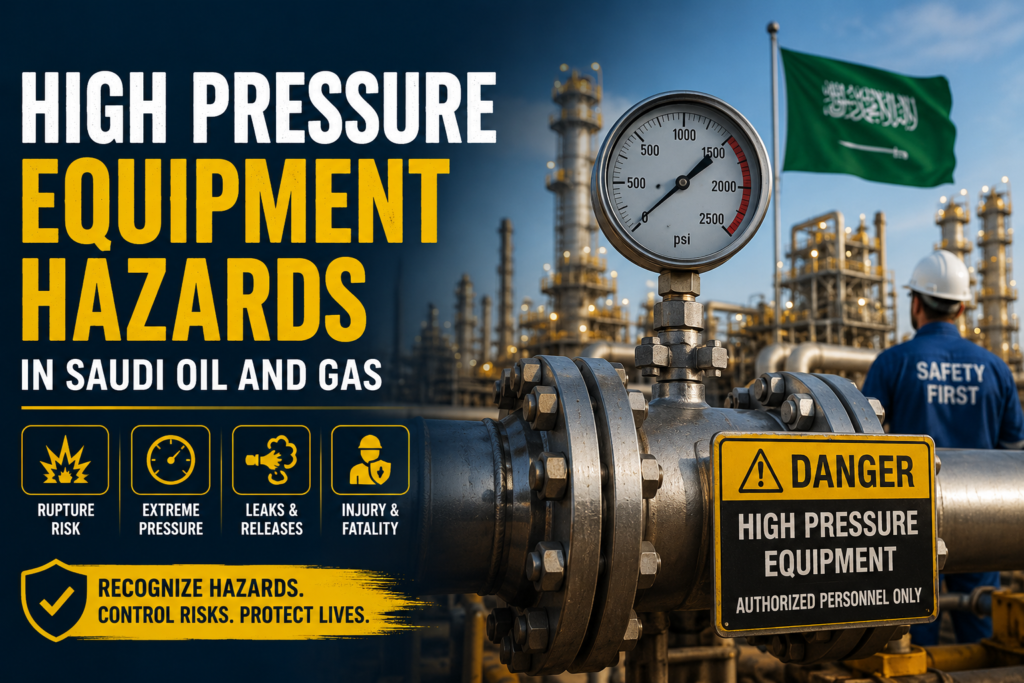
A pressure vessel operating at 1,500 psi holds roughly the same stored energy as several sticks of dynamite. When that vessel fails, it does not fail quietly. A rupture sends fragments at velocities that defeat most PPE, releases whatever is inside as an instantaneous flash, and creates an overpressure wave that damages everything in its radius. In an Eastern Province facility where process lines, electrical equipment, and other workers occupy the same space, the consequences of a single pressure failure can be catastrophic within seconds.
In a study analyzing 46 years of chemical industry accidents in Saudi Arabia, explosions accounted for over 20 percent of all registered incidents, with Jubail recording the highest number of incidents in the Eastern Province. High pressure equipment failures are not a theoretical risk in this environment. They happen, and they happen in the same facilities where your team works every day.
This guide covers the specific hazards that high pressure equipment creates in Saudi oil and gas operations, why failures occur, what the real consequences are, and what operational controls actually reduce the risk.
What Counts as High Pressure Equipment
In oil and gas operations, high pressure equipment refers to any system designed to contain, convey, or process fluids or gases above 15 psi. In practice, the equipment your teams encounter daily operates at far higher pressures than that threshold.
Common categories of high pressure equipment include pressure vessels, pipelines, compressors, pumps, wellheads, and blowout preventers. In a typical Eastern Province facility, you might have all of these in close proximity: a separator vessel receiving well fluids, a high-pressure pipeline moving gas downstream, a centrifugal compressor boosting pipeline pressure, and a wellhead tree controlling the production zone.
Each of these systems carries its own failure modes, and they do not operate independently. A compressor fault that causes downstream overpressure affects everything connected to it. Understanding the hazards requires understanding how these systems interact, not just how each one behaves in isolation.
The Six Main Hazards High Pressure Equipment Creates
1. Catastrophic Vessel Rupture
The serious hazards related to the catastrophic failure of pressure vessels include being struck by high energy materials from the vessel and its contents, fire and explosion, and depending on the vessel’s contents, the release of toxic or corrosive materials.
A vessel that ruptures under pressure does not simply leak. The stored energy releases instantaneously. Fragments become projectiles. The sudden pressure drop causes flash vaporization of liquid contents. If the fluid is flammable, ignition is likely. If it contains hydrogen sulfide, a toxic cloud disperses before anyone has time to respond.
The scale of the hazard is proportional to operating pressure, vessel volume, and the nature of the contents. A 10,000-litre separator vessel operating at 600 psi in a gas gathering facility carries significantly more destructive potential than a small instrument air receiver. Both require respect for the engineering limits they were designed to.
2. Overpressure Events
Overpressure occurs when the pressure inside a vessel or pipeline exceeds its design limits. It is one of the most common causes of pressure system failures in oil and gas, and it is almost always preventable.
Causes of overpressure events include blocked outlet valves that trap pressure with no relief path, control valve failures that allow upstream pressure to pass unchecked, thermal expansion of trapped liquid in an isolated section of pipe, exothermic reactions in process vessels where heat generation was not anticipated in the design, and relief valve failures that prevent the safety system from functioning when it is most needed.
Failure to manage and control pressure effects can cause serious equipment damage and injury, or loss of life. Improperly managed well control situations can cause blowouts, which are uncontrolled and explosive expulsions of formation hydrocarbons from the well, potentially resulting in fire.
In Saudi Arabia’s upstream operations, overpressure at the wellhead level is particularly serious. Formation pressures in the Ghawar and Shaybah fields are significant, and a loss of well control without functional blowout prevention equipment in place creates exactly this scenario.
3. High Pressure Jet Releases
A pinhole leak or fitting failure in a high-pressure line does not produce a gentle drip. At pressures above 100 psi, fluid exits as a high-velocity jet capable of cutting through skin and soft tissue at distances of several metres. Workers who attempt to locate leaks by touch on pressurized systems have suffered serious injection injuries from exactly this mechanism.
The hazard compounds when the released fluid is flammable. A fine mist of hydrocarbon or condensate disperses rapidly, creating a vapor cloud that ignites from any nearby ignition source. Hot work permits exist partly because of this specific scenario: a leak that was not present at the start of a shift can develop during operations, and a welding arc nearby turns a maintenance task into a fire incident.
4. Pressure Testing Incidents
Cracked and damaged vessels can result in leakage or rupture failures. Potential health and safety hazards of leaking vessels include poisonings, suffocations, fires, and explosion hazards. Rupture failures can be much more catastrophic and can cause considerable damage to life and property.
Pressure testing is where many incidents occur. Hydrostatic testing of pipelines and vessels brings systems to test pressures that exceed operating pressure by a defined margin, typically 1.5 times the design pressure. If the test is conducted with gas rather than water (pneumatic testing), the stored energy at test pressure is orders of magnitude higher than a hydraulic test at the same pressure.
Pneumatic testing is more dangerous than hydrostatic testing for this reason, and in Saudi Arabia’s petrochemical and pipeline sectors, the requirements around test procedures, exclusion zones, and qualified personnel are non-negotiable. Improper pressure testing procedures have caused fatalities in the region.
5. Thermal and Mechanical Fatigue
Pressure systems in Saudi Arabia’s Eastern Province operate in some of the most thermally challenging environments in the world. Temperatures above 50 degrees Celsius are not unusual in the Eastern Province, and these conditions affect equipment year-round, not just seasonally.
Cycling between ambient temperatures and operating temperatures, combined with process fluid temperatures that can exceed 300 degrees Celsius in refinery applications, creates thermal fatigue in vessel walls, welds, and nozzle connections. Over time, this fatigue develops into cracks that are not visible during routine walk-around inspections. It requires non-destructive testing: ultrasonic thickness measurement, magnetic particle inspection, or radiographic examination to detect before failure occurs.
Mechanical fatigue from vibration is a related concern, particularly at compressor stations and pump skids where pulsation in the process creates cyclic loading on connected pipework. Small-bore piping connections on high-vibration equipment are a known failure point in many facilities.
6. Corrosion and Wall Thinning
Feed water pipe failures have been attributed to wall thinning as a result of erosion and corrosion, leading to rupture of the pipes under high working pressures. The same mechanism applies throughout oil and gas operations.
In Saudi Arabia’s upstream operations, produced water contains chlorides, carbon dioxide, and hydrogen sulfide, all of which accelerate corrosion of carbon steel. Sand production from the formation causes erosion at bends and constrictions. Internal corrosion rates that were not accounted for in the original design can reduce pipe wall thickness below minimum safe levels within years rather than decades if not monitored and managed.
External corrosion from soil contact and atmospheric moisture also degrades buried and insulated pipework in ways that are not visible without intrusive inspection or advanced corrosion monitoring.
Why High Pressure Equipment Failures Happen
Understanding root causes matters more than understanding failure modes, because root causes are where prevention happens.
Inadequate inspection and maintenance. Pressure systems require scheduled inspection to API 510 (pressure vessels), API 570 (piping), or equivalent standards. When inspection intervals are extended without engineering justification, or when inspection findings are closed out on paper without actual repairs, the system’s fitness for service deteriorates without anyone knowing until it fails.
Inadequate operating procedures. Workers might be exposed to uncontrolled electrical, mechanical, hydraulic, or other sources of hazardous energy if equipment is not designed, installed, and maintained properly, and administrative controls such as operating procedures must be developed and implemented to ensure safe operations. Pressure systems without written, trained, and enforced operating procedures are systems waiting to be overpressured by a sequence of actions that nobody individually recognized as dangerous.
Bypassed or defeated safety systems. Relief valves removed for cleaning and not replaced. High pressure alarms acknowledged and silenced without investigating the cause. Blowout preventer function tests overdue. Every bypassed safety system is a layer of protection removed from the barrier model, and high-pressure equipment failures almost always involve multiple barriers that were degraded before the incident.
Inadequate competency. Workers operating valves, changing out fittings, or isolating equipment on high-pressure systems need to understand what they are working on. A valve that is closed when it should be open, or opened when the downstream system has not been depressured, creates overpressure scenarios. Competency in pressure system safety is not common sense. It requires specific training.
Controls That Actually Work
Effective pressure hazard management in Saudi oil and gas operations relies on engineering controls first, then administrative controls, then PPE. The hierarchy matters.
Engineering controls: Pressure relief valves sized and set correctly for the worst-case overpressure scenario. Pressure safety valves with documented set points, tested at documented intervals. High-high pressure shutdowns that isolate the source before relief devices have to operate. Blowout prevention equipment maintained and function-tested per API 53.
Permit to work and isolation. Any work on a pressurized system requires a written isolation certificate confirming the system has been depressured, vented, and locked out. Implementing procedures and processes including adequate well control procedures, and installing and using equipment such as blowout preventers to prevent or minimize blowouts, is a critical operational requirement.
Inspection and integrity management. A documented inspection plan for every pressure vessel and pipeline, with risk-based inspection intervals informed by corrosion rates, operating history, and consequence of failure. Inspection findings tracked to closure, not just recorded.
Training. Workers who operate, maintain, or work near high pressure equipment need training that goes beyond generic safety awareness. They need to understand the specific hazards of the equipment they work with, the signs of developing problems, and exactly what to do if something goes wrong. OSHA 30-hour training covers the regulatory framework. Specific pressure system competency programs build the operational knowledge that regulatory training alone does not provide.
The Saudi Regulatory and Client Context
High pressure equipment in Saudi Arabia’s oil and gas sector operates under multiple layers of regulatory and client requirements.
Saudi Aramco’s engineering standards, including SAES-A-004 on pressure relief and SAES-L-100 series on piping, define the technical requirements for pressure system design, inspection, and operation across Aramco-operated and contractor-operated facilities. SABIC applies equivalent requirements through its own engineering standards.
The Saudi Ministry of Human Resources’ occupational safety regulations establish baseline requirements for hazardous equipment, pressure testing procedures, and worker competency. These apply regardless of client-specific standards.
For contractors and service providers working across multiple clients in the Eastern Province, understanding both the regulatory baseline and client-specific requirements is a competency requirement in itself.
Frequently Asked Questions
What is the most common cause of pressure vessel failure in oil and gas?
Corrosion and wall thinning from internal process fluids is the most common long-term failure mechanism. Overpressure from operational errors or relief system failures is the most common cause of sudden catastrophic failure.
What training do workers need for high pressure equipment in Saudi Arabia?
Workers operating or maintaining high pressure equipment need training covering pressure system fundamentals, isolation and depressuring procedures, permit to work requirements, and emergency response. OSHA 30-hour general industry or construction training provides the regulatory framework. Role-specific equipment training builds on that foundation.
What is a blowout preventer and when is it required?
A blowout preventer (BOP) is a large valve or series of valves installed at the wellhead to control formation pressure and prevent uncontrolled flow of hydrocarbons from the well. BOPs are required on all drilling and workover operations in Saudi Arabia per API 53 requirements and Saudi Aramco standards.
How often should pressure relief valves be tested in Saudi Arabia?
Testing intervals depend on the service, the fluid handled, and the applicable engineering standard. Most pressure relief valves in oil and gas service are tested on intervals of one to five years. Aramco and SABIC standards specify testing requirements for facilities under their purview.
Build Your Team’s Competency in High Pressure Safety
EUTC Global delivers safety training programs for oil and gas, construction, and industrial professionals across Saudi Arabia, based in Al Khobar in the Eastern Province. Programs relevant to high pressure equipment hazards include OSHA 30-hour training, process safety fundamentals, and permit to work competency programs.
For organizations in the Aramco and SABIC supply chain managing high-pressure operations across the Eastern Province, EUTC Global’s training programs are designed to build the operational competency that regulatory compliance alone does not deliver.
Explore OSHA 30 Training | View All Safety Training Courses | Contact EUTC Global
Al Khobar, Eastern Province, Saudi Arabia