

Contents
- 1 What Is LOTO (Lockout Tagout)?
- 2 Why Is Lockout Tagout Mandatory in Saudi Industry?
- 3 What Happens Without a LOTO Program? The Numbers
- 4 The 6 Steps of a LOTO Procedure
- 5 Who Needs LOTO Training? Authorized vs Affected Employees
- 6 LOTO and Aramco / SABIC Vendor Requirements
- 7 How EUTC Global Delivers LOTO Training in Saudi Arabia
- 8 FAQ
Every year, workers across Saudi Arabia’s oil, gas, and construction sectors are injured by equipment that restarts unexpectedly during maintenance. LOTO training in Saudi Arabia exists to stop exactly this. Lockout Tagout (LOTO) is the procedure that isolates hazardous energy before anyone services a machine, and it is mandatory because the alternative shows up in injury statistics, not just compliance audits. For companies supplying Saudi Aramco, SABIC, or any major industrial operator, a documented LOTO program is a pre-qualification requirement, and the crews running it need to be trained correctly.
What Is LOTO (Lockout Tagout)?
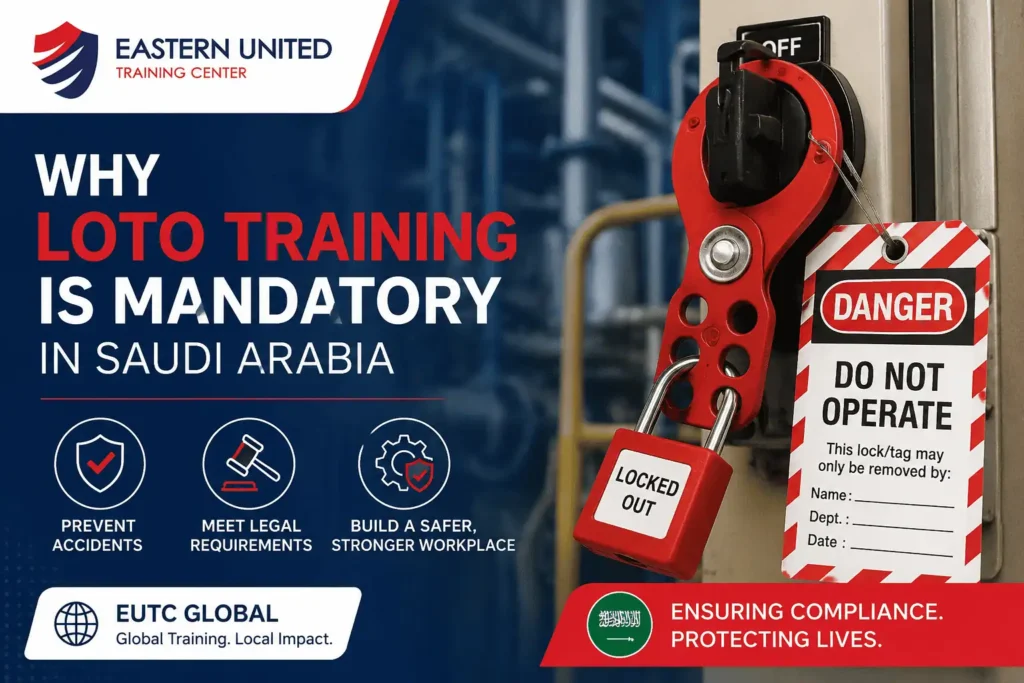
Lockout Tagout (LOTO) is a safety procedure that isolates hazardous energy sources, electrical, mechanical, hydraulic, pneumatic, chemical, or thermal, before equipment is serviced or repaired. A lock physically holds the energy isolating device in the off position. A tag identifies who applied it and why. Together, they stop a machine from restarting while a worker is exposed to it.
LOTO applies to almost any equipment with a power source: pumps, compressors, conveyors, valves, electrical panels, and pressurized lines. In oil and gas facilities, it covers everything from a small motor on a skid to a full process unit shut down for a turnaround.
Why Is Lockout Tagout Mandatory in Saudi Industry?
LOTO is mandatory in Saudi industry because the country’s largest employers require it as a condition of doing business. OSHA’s 29 CFR 1910.147 standard sets the international benchmark for hazardous energy control, and Saudi Aramco applies the same principle through its own internal General Instruction on isolation, lockout, and hold tags, covering its facilities and every vendor site.
For Aramco and SABIC vendors, a working LOTO program is part of the Contractor Health, Safety, and Environmental Performance (CHSEP) evaluation. Companies that cannot demonstrate a documented energy control procedure, with trained authorized employees, risk losing pre-qualification status before a contract is even signed.
Saudi Labour Law also places a general duty on employers to provide a safe working environment, and Vision 2030’s industrial expansion is multiplying the number of plants, pipelines, and maintenance contracts where that duty applies. More turnarounds and more contractor crews on site mean more points where an unisolated energy source can hurt someone. Top 10 mandatory safety trainings for Aramco vendor companies covers LOTO alongside the other certifications vendors are expected to hold before mobilizing to site.
What Happens Without a LOTO Program? The Numbers
Skipping LOTO does not save time. It creates the conditions for one of the most preventable categories of industrial injury. OSHA attributes approximately 120 fatalities and 50,000 injuries every year to hazardous energy incidents in U.S. workplaces alone, almost all preventable with a correctly applied lockout procedure. Certaintysoftware
Globally, the picture is larger. ILO global estimates put occupational accident deaths at 330,000 in 2019, with over 395 million workers sustaining a non-fatal occupational injury that year. Energy isolation failures, equipment restarting unexpectedly or stored energy releasing without warning, sit inside that figure as one of the most consistently recurring causes. ILOSTAT
In a Saudi industrial setting, the risk concentrates around two moments: shift handovers, where one crew assumes equipment is already isolated because another crew said so, and contractor mobilization, where an outside team applies its own lock without first confirming the host facility’s isolation points. Both are training problems, not equipment problems.
The 6 Steps of a LOTO Procedure
A correctly applied LOTO procedure follows the same sequence regardless of the equipment involved:
- Prepare. Identify the equipment to be serviced and every energy source feeding it, electrical, hydraulic, pneumatic, mechanical, or thermal.
- Notify. Inform all affected employees that the equipment is going down for lockout before work begins.
- Shut down. Stop the equipment using its normal operating controls, not by forcing or bypassing them.
- Isolate. Operate the energy isolating devices, breakers, valves, disconnect switches, so the equipment is physically disconnected from every energy source.
- Lock, tag, and dissipate. Apply a personal lock and tag to each isolating device, then release any stored energy such as spring tension, residual pressure, or a suspended load.
- Verify. Attempt to start the equipment using its normal controls to confirm isolation is effective, then return controls to neutral before work begins.
Only after step 6 is confirmed should anyone begin maintenance, repair, or inspection work.
Who Needs LOTO Training? Authorized vs Affected Employees
OSHA’s standard, and Saudi Aramco’s adopted version of it, splits the workforce into two training categories based on their relationship to the locked-out equipment.
| Role | Who They Are | Training Required |
|---|---|---|
| Authorized employee | Applies the lockout/tagout devices and performs the service or maintenance | Full LOTO procedure: energy source identification, isolation steps, lock and tag application, verification |
| Affected employee | Operates or works near the equipment but does not perform the lockout | Awareness training: recognizing locks and tags, the prohibition on removing another person’s lock, reporting concerns |
Anyone whose role can shift between these two categories, a maintenance technician who sometimes operates the equipment they service, needs authorized-employee training. EUTC Global’s LOTO safety training program covers both tracks within a single course, with separate competency checks for each role.
LOTO and Aramco / SABIC Vendor Requirements
Vendors working inside Aramco or SABIC facilities operate under the host’s energy control procedures, not their own. This is where most LOTO failures on contractor sites originate.
A crew arrives with its own locks, its own tags, and its own assumptions about how isolation works. The host facility’s procedure was written for its own personnel and may not have been translated for an outside contractor. When a contractor is told equipment is “already locked out, go ahead” without placing their own lock on the isolation point, the personal protection the entire system is built around disappears.
The fix is procedural. Before mobilization, every contractor crew should receive the equipment-specific isolation procedure for the job they are performing, built into the permit-to-work process, not a generic site induction. LOTO is frequently a prerequisite for confined space entry training in Saudi Arabia, since most confined spaces in process plants cannot be entered until connected lines and equipment are isolated and verified. The confined space entry permit process in Saudi Arabia walks through how the two procedures connect on a live permit.
How EUTC Global Delivers LOTO Training in Saudi Arabia
EUTC Global delivers LOTO training at its Al Khobar centre and on-site at client facilities across the Kingdom, in Arabic and English. The course covers OSHA 29 CFR 1910.147 requirements alongside the Saudi Aramco isolation and hold tag standard, so authorized and affected employees leave with certification recognized in Aramco and SABIC vendor audits.
For companies building a complete site safety program, LOTO training sits alongside oil and gas safety training in Saudi Arabia, confined space entry, and permit-to-work training as part of the standard pre-mobilization package for Eastern Province contractors.
FAQ
Is LOTO training mandatory for Aramco vendors in Saudi Arabia?
Yes. Saudi Aramco requires contractors to operate under its isolation, lockout, and hold tag standard as part of CHSEP evaluation. Vendor crews must demonstrate trained authorized employees and a documented energy control procedure before mobilizing to an Aramco site for maintenance or construction work.
What is the difference between lockout and tagout?
Lockout is the physical device, a padlock, that holds an energy isolating device in the off position so it cannot be operated. Tagout is the warning tag attached to that device, identifying who applied it and why. OSHA treats lockout as the primary control and tagout as the supporting communication tool.
How long does LOTO training take?
A standard LOTO awareness and authorized-employee course runs one day, combining classroom instruction on energy types and isolation procedures with hands-on practice applying locks and tags to representative equipment. Refresher training is typically required annually or after any procedure change.
Does LOTO apply to confined space work?
In most cases, yes. Before a worker enters a confined space connected to process equipment, every line, valve, and energy source feeding that space must be isolated, locked, tagged, and verified. LOTO is usually completed before the confined space entry permit is issued, not during entry itself.
What standards govern LOTO in Saudi Arabia?
LOTO programs in Saudi Arabia are typically built around OSHA’s 29 CFR 1910.147 standard and ANSI Z244.1, the same frameworks referenced internationally. Saudi Aramco applies its own internal General Instruction covering isolation, lockout, and hold tags, which contractors must align with on Aramco sites.
Who is allowed to remove a lockout device?
Only the authorized employee who applied the lock and tag may remove it under normal conditions. If that person is unavailable, removal requires a documented procedure involving the supervisor, confirmation that the original employee is safe and notified, and a record of who removed the device and when.
LOTO is one of the safety certifications Aramco and SABIC vendors are expected to hold before sending crews to site. Enrol in oil and gas safety training at EUTC Global to get your authorized and affected employees certified at our Al Khobar centre or on-site anywhere in the Kingdom.