
Contents
- 1 The KSA Site Environment Makes Everything Harder
- 2 1. Dropped Loads — Still the Most Common Fatal Incident
- 3 2. The Sling That Looks Fine But Isn’t
- 4 3. Nobody Told the Load It Was Supposed to Stay Still
- 5 4. The Communication Problem Nobody Talks About Enough
- 6 5. Production Pressure — The Risk Nobody Puts in the Risk Register
- 7 What Proper Rigging Training Actually Looks Like
- 8 Before Your Next Lift — A Practical Check
- 9 One Last Thing
Let me tell you about something I’ve seen more than once on Eastern Province sites.
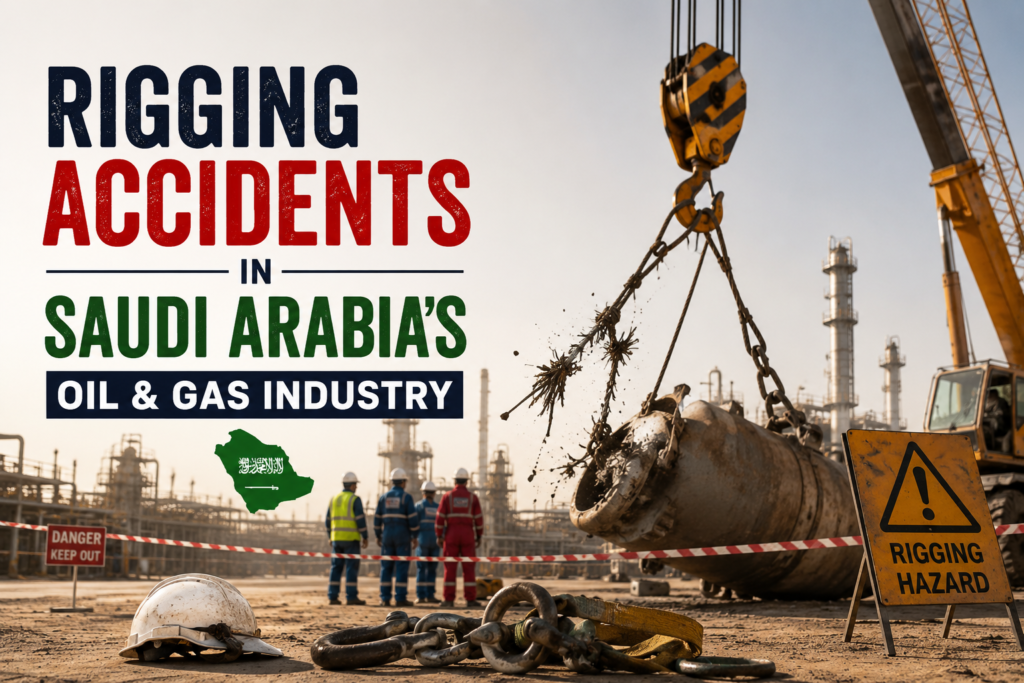
A crew is doing a lift. Nothing complicated — a valve assembly, maybe 800 kg. The banksman gives the signal. The crane operator lifts. And then the load starts to swing — slow at first, then faster — because nobody used a tag line, and the centre of gravity wasn’t where anyone thought it was.
Nobody got hurt that time. The load swung into a pipe rack and caused about three days of unplanned work. But it could have gone very differently.
That’s the thing about rigging incidents on KSA oil & gas sites. Most of them don’t announce themselves. They build quietly from small decisions — a sling that wasn’t inspected, a weight that wasn’t calculated properly, a signal that meant two different things to two different people. And then one day, those small things line up.
I’m writing this because those accidents are preventable. Not in theory. Actually preventable, if you know what you’re looking at.
The KSA Site Environment Makes Everything Harder
Before I get into the specific accidents, I want to say something that most safety articles skip over: rigging on a KSA oil & gas site is not the same as rigging anywhere else.
I’m not being dramatic. The conditions here create risks that a standard rigging manual — written in Europe or the US — does not fully prepare you for.
The heat is the obvious one. When it’s 47°C on a Jubail site in July and your rigger has been working since 6am, he is not thinking as clearly at 11am as he was at the start of the shift. Heat fatigue is real, it’s measurable, and it affects decision-making. That sling angle calculation that takes two minutes when you’re fresh? It takes longer when your brain is working against the heat. And sometimes it doesn’t happen at all.
Then there’s the dust. Sand gets into wire rope. It gets into shackle threads. It accelerates wear on synthetic slings in ways that manufacturers’ specs — written for warehouses in Germany — don’t account for. Equipment here degrades faster. That’s just the reality.
And then there’s the communication issue, which I think is genuinely the most underestimated risk factor on KSA sites. You might have a Filipino banksman, a Pakistani rigger, an Egyptian site supervisor, and a British crane operator. They’re all experienced. But they learned their hand signals in different countries, from different people, and those signals are not always the same. “Move slowly” in one system looks like “stop” in another.
I’ve seen this cause a near-miss. I’ve heard of it causing worse.
All of this is the backdrop. Now let’s talk about what actually goes wrong.
1. Dropped Loads — Still the Most Common Fatal Incident
I’ll start here because this is the one that kills people.
A dropped load — where a load becomes unsecured during a lift and falls — is the most common fatal rigging incident across oil & gas globally, and it’s no different in Saudi Arabia. A pipe section, a pressure vessel, a pump — these things weigh hundreds or thousands of kilograms. When they fall, the margin for error is zero.
What I’ve noticed is that dropped loads almost never happen because someone was careless in a simple way. They happen because of a chain of small failures that each seemed minor.
The sling was selected by eye rather than by calculation. The shackle pin wasn’t moused because “it never backs out.” The tag lines weren’t used because “it’s a short lift, we’ll be fine.” The load shifted because the centre of gravity was different from what anyone expected — because nobody had checked.
What actually prevents dropped loads:
- Calculate actual load weight every single time. Not estimated. Actual. For complex assemblies, that means getting the number from the fabricator or weighing it.
- Mouse every shackle pin without exception. It takes 30 seconds. The one time you skip it is the one time it matters.
- Check your sling angle before every lift. At 60°, your sling capacity drops by nearly 30% compared to a vertical lift. Most riggers know this in training. Far fewer apply it consistently on site.
- Keep everyone out of the load path. Not to the side. Out. Completely.
2. The Sling That Looks Fine But Isn’t
This one is harder to see coming, which is what makes it dangerous.
Synthetic slings degrade. Wire ropes degrade. Shackles degrade. On a KSA site, they degrade faster than the label suggests — because of UV exposure, because of heat, because of sand, because of contact with chemicals that are everywhere on a process site.
A synthetic sling sitting in direct Saudi sun between lifts is losing service life. The outside might look fine. The polyester fibres inside are being broken down. You won’t know until the sling fails.
I’ve seen riggers here use equipment that clearly had no business being in service — slings with the identification tag completely gone, wire ropes with visible kinks that nobody removed from circulation, shackles so corroded that the bow had visibly deformed. And when you ask about it, the answer is usually some version of: “It’s been used before, it’s fine.”
That logic ends careers. Sometimes it ends lives.
What actually prevents equipment failure:
- Inspect every piece of rigging hardware before every lift. Not a glance. An actual check — look at the sling along its full length, open the shackle and look at the pin, check the hook latch.
- If the identification tag is gone, the equipment comes out of service. No exceptions. You don’t know its capacity, its inspection history, or its age.
- Store synthetic slings indoors or in shade. This is simple. It almost never happens. It should always happen.
- Implement a colour-coded tagging system with quarterly competent-person inspections. Anything out of date comes off the job.
3. Nobody Told the Load It Was Supposed to Stay Still
Uncontrolled load swing. I’ve seen this one go from “minor incident” to “serious investigation” based entirely on where people happened to be standing.
A load starts swinging during a lift for a few reasons: no tag line, wrong tag line technique, wind picked up, centre of gravity wasn’t where the rigging team thought it was. On an open desert site in the Eastern Province, a shamal wind can appear and strengthen within minutes. A load that was perfectly controllable at lift becomes a pendulum by the time it’s at height.
On a congested oil & gas site — and most KSA process sites are congested — a swinging load of any significant weight will find something to hit. Pipe racks, instrumentation, scaffolding, other workers.
What actually prevents this:
- Tag lines on every lift. And I mean properly used tag lines — held by someone who’s been shown how to control a moving load, not just handed to the nearest worker to hold.
- Set a wind speed limit and enforce it. Write it into the lift plan. If the wind is above the limit, the lift stops. Not pauses. Stops.
- Do a test lift — raise the load a few inches off the ground, hold it, and check stability before committing to the full lift. This takes maybe 60 seconds and it tells you immediately if the rigging is right.
- Crane operator lifts only on the banksman’s signal, and the banksman signals only when the rigger has confirmed ready. One voice to the crane operator. Not three.
4. The Communication Problem Nobody Talks About Enough
I want to spend more time on this one because I think it’s the most overlooked cause of rigging incidents in the KSA context specifically.
Most safety training talks about communication in a generic way — “ensure clear communication,” “use standardised signals.” That’s fine as far as it goes. But on a Saudi Aramco-affiliated project with workers from twelve countries, “standardised signals” only works if everyone was standardised to the same system.
They usually weren’t.
The solution isn’t complicated, but it requires deliberate effort. Before any lifting campaign starts, every member of the rigging team — rigger, banksman, crane operator, supervisor — should be in the same room going through hand signals together. Not reading them from a poster. Demonstrating them, confirming understanding, and agreeing that these are the only signals that will be used on this site.
What actually prevents communication failures:
- One person communicates with the crane operator. One. Everyone else goes through the banksman.
- If the banksman loses sight of the crane operator or the rigger at any point, the lift stops.
- Radio communications during lifts get a dedicated channel. Not the general site channel — a lifting-specific channel with no other traffic during operations.
- Before a multi-nationality crew starts a lifting campaign together, do a signal alignment session. It takes an hour. The paperwork from a communication-caused incident takes months.
5. Production Pressure — The Risk Nobody Puts in the Risk Register
I’ll be direct about this one.
On busy KSA oil & gas sites, there is pressure to keep lifting operations moving. Schedules are tight. Crane time is expensive. Supervisors have targets. And in that environment, the step that gets cut first is usually the pre-lift check.
“It’s a quick lift.” “We’ve done this before.” “We’re running behind, just go.”
I’m not saying this happens on every site or with every supervisor. But I am saying I’ve seen it, and I’ve seen what comes after it. The “quick lift” that nobody wrote a lift plan for, on a load that nobody weighed, with equipment that nobody inspected — because everyone was confident and experienced and in a hurry.
The solution here isn’t technical. It’s cultural. It’s about having the kind of site where a rigger feels able to stop a lift because something doesn’t feel right, without worrying about what the supervisor will say.
That culture doesn’t come from a poster on the welfare cabin wall. It comes from the way management responds the first time someone stops a lift and explains why. If that person gets thanked, the culture moves in the right direction. If they get pressured, it doesn’t.
What Proper Rigging Training Actually Looks Like
I want to say something about training here, because “training” has become a word that can mean almost anything from a one-hour e-learning module to a genuine multi-day practical programme.
Most rigging incidents I’ve described in this blog could have been prevented by proper training. Not awareness training. Not a toolbox talk. Actual rigging competency training — where a rigger learns to calculate sling angles with real equipment, inspects actual rigging hardware and identifies defects, practices communication protocols in a team setting, and is assessed on whether they can do these things correctly.
That’s what EUTC’s Rigger Training is built around. We’re based in Al Khobar, which means we understand the Eastern Province environment — the heat, the site conditions, the multilingual teams, the Aramco-linked project requirements. Our instructors have worked on the same kinds of sites these incidents happen on. They’re not reading from a generic manual written somewhere else.
We cover:
- Load weight calculation and sling capacity at real angles
- Rigging hardware inspection — what to look for, what to retire, what to report
- Proper hitching methods and when each applies
- Hand signals and communication in mixed-nationality teams
- Pre-lift planning and toolbox talk structure
- Hazard recognition specific to oil & gas environments
We also deliver on-site — if you have a crew that can’t leave the project, we come to you.
If you’re preparing a team for a lifting campaign, or if you’ve had a near-miss and you’re reviewing your rigging competency programme, reach out to EUTC. We’ll tell you honestly what your programme needs.
Before Your Next Lift — A Practical Check
Not a compliance checklist. Just the things that actually matter:
Load and gear:
- Do you actually know the weight of this load — not estimated, known?
- Is the WLL of your slings, shackles, and hooks confirmed for this weight at this sling angle?
- Has every piece of equipment been physically inspected today?
- Are all tags present and legible?
People and communication:
- Does everyone on this lifting team use the same hand signals — confirmed together, today?
- Is there one and only one person communicating with the crane operator?
- Is the banksman in position to see both the rigger and the crane operator?
Site conditions:
- What’s the wind doing? Is it within your site limit?
- Is the exclusion zone physically marked and clear of people?
- Does anyone have a reason to think this lift shouldn’t proceed right now?
That last question is the most important one. If the answer is yes, the lift stops.
One Last Thing
Rigging incidents in KSA oil & gas are not random. They come from identifiable patterns — skipped inspections, uncalculated loads, communication gaps, production pressure. Every single one of those patterns can be broken.
The question isn’t whether you know that. The question is whether your site’s riggers have been trained to the level where they can break those patterns themselves, in real conditions, under pressure.
If the answer isn’t a confident yes, that’s worth addressing now.